








Story of a Senior Horse: Lessons for Lucky

Rodney, Ontario – My mom and I have a 32-year-old horse. His name is R Lucky Tramp. We call him Lucky. We are all senior citizens – Lucky, Mom and now me. Recently, my Mom asked a really good question. “What do I do if I find Lucky down?” (Our vet is over an hour away.)
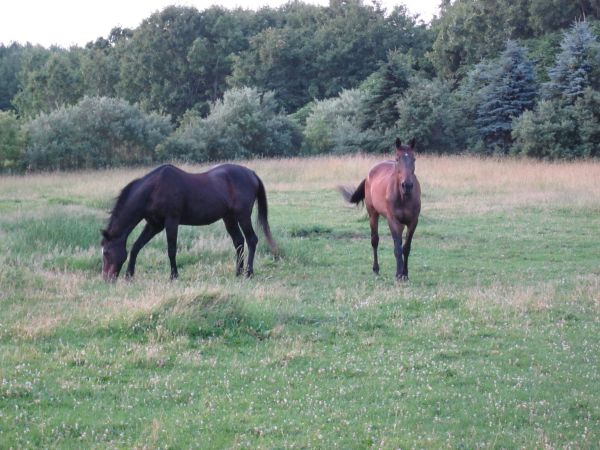
Senior horses enjoy their golden years together: 22-year-old Sam (left) and 32-year-old Lucky (right). Photo courtesy of Equine Guelph.
The question was at once uncomfortable and important. I discussed it with our vet and also Gayle Ecker, who serendipitously, is my work colleague and director of Equine Guelph. Next thing I know, the Equine Guelph team has talked me into writing an article to share lessons I’m learning about our aging horse!
Although emotional and personal for me – he is our last horse – I hope Lucky’s story reaches many at a time when equine veterinarians are often few and far between.
Lucky is a homebred, the last in a Standardbred line in which our horse and human families have been together for well over a century. Deep, deep, roots, his great-great-great-great grandmother Daisy Wilkes raced on the frozen waters of the Detroit River in 1909; we still have her ice shoes from that winter day.
Lucky had a long, successful career as a racehorse, retiring from harness racing 20 years ago at the age of 12. He lives with Sam, our neighbour’s rascally 22-year-old Thoroughbred, on our pioneer farm in southwestern Ontario. The ‘old boys’ have eight acres of lush pasture between them. They come and go as they please – in and out of big old barn. Life is good.
Lesson #1 – The carrot trick
Over the last couple years, we began to notice that Lucky was coming out of winters a bit leaner and stiffer. We have been watching him closely – his movement, his body condition. Last fall, we had a serious discussion about putting him down ahead of winter, but decided to try two new approaches – a senior feed with a high fat content and anti-inflammatory medication. Since Sam and Lucky share everything, Lucky gets his pill hidden deep in a carrot!
Lo and behold, he turned into a different horse. On Christmas Day we looked out the window and saw him buck! He even started to protest some of Sam’s bossy moves. Gayle Ecker said she wasn’t surprised – that limited locomotion can lead to stress and isolation.
Fortunately, Lucky is doing well – bulking up, walking freer – but we continue to watch him carefully every day – making sure that the end-of-life decisions we will be making on his behalf are responsible ones. Now, this brings us back to my Mom’s question.
Lesson #2 – What do I do if I find Lucky down?
I asked the question to our vet who, you will recall, is over an hour away. She said, “Call me, but I wouldn’t be opposed to a neighbour with a gun.” In the moment, I was taken aback, but then started to seriously consider the idea of reducing suffering – even if for an hour less.
Back I went to Gayle for more advice. Keep in mind, her mantras are “It’s not about you” and “Better a week early than one day late!” She immediately agreed with the vet’s recommendation and told me where to find directions for euthanasia by gunshot – Appendix I (p.81) in the Code of Practice for the Care and Handling of Equines. “Remember,” Gayle added, “everyone thinks the target is between the eyes. It is actually above the eyes. If done precisely, a bullet can be an instantaneous and humane method as outlined in the Code of Practice.”
My cousin, hunter and conservationist, lives a mile away and is now on board. He has joined Team Lucky! He has been briefed and the reference page in the Code of Practice bookmarked in case he needs a last-minute refresher – if it comes to that.
Lesson #3 – Never stop learning
So, I am now breathing a sigh of relief. We have learned big lessons lately. We have a plan. When the day comes to say good-bye, whether scheduled or not, the final decision will be for Lucky, not us. Hard. Necessary.
In the meantime, I will continue learning about horses – especially senior horse health. Getting information from a credible source (i.e., your vet, trusted evidence-based organizations) is so important in these days of easy access to misinformation!
Each fall, in support of aging equids, Equine Guelph names September “Senior Horse Education Month.” If you have a senior horse, or will one day, I strongly urge you to take advantage of Equine Guelph’s online resources this month:
- Free interactive tool – Senior Horse Challenge
- Two-week online course led by senior horse expert Dr. Bettina Bobsien, running September 21-October 2, 2026 – The Senior Horse
I would like to thank the team at Boehringer Ingelheim for supporting Equine Guelph’s educational programs in the senior horse category. They have funded the development and delivery of senior horse resources for over 12 years. We salute their commitment and passion to this sometimes forgotten segment of the horse population.
Finally, I extend my personal thanks to Gayle Ecker who has been my consummate frontline teacher of anything horses – but also a teacher to thousands of students around the world through Equine Guelph’s online education program which launched over two decades ago – the first of its kind in the world.
There is so much to know about these majestic creatures, so please keep learning – for them – for you.
Story by: Henrietta Coole
Shared from Equine Guelph, August 31, 2026: Story of a Senior Horse: Lessons for Lucky – The Horse Portal