








Research Update: Block Salt or Loose Salt?

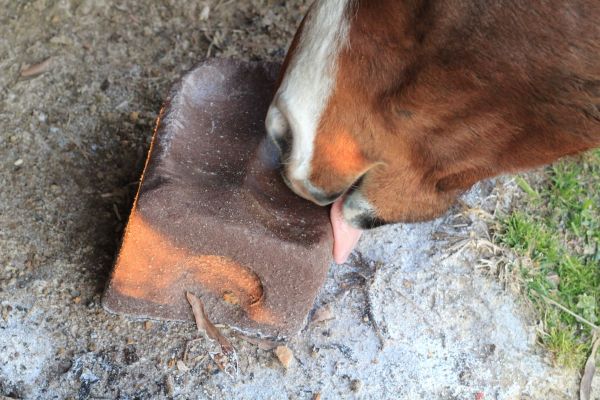
AdobeStock image
From UMN Extension:
Sodium and chloride, found in table salt, are essential for supporting hydration as well as muscle and nerve function in horses. Horse owners often supplement forage diets that are low in sodium by providing horses free access to a salt block. However, whether horses can readily consume salt by licking a block is not well studied.
Researchers at Colorado State University compared salt intake of horses offered a white salt block or plain loose, white salt. Sixteen mature horses were split into two groups of eight. In each group, half the horses received full turnout while the other half received partial turnout in individual paddocks. The groups were assigned to either block salt or loose salt (4 pounds) for a 7-day period. During this time, the horses had free access to water, had moderate exercise, and were fed cool-season grass hay with a ration balancer. The researchers weighed salt before and after the period, and recorded daily water intake. These methods were repeated for three additional periods, where groups alternated between block and loose salt.
The form of salt, block or loose, did not influence the horses’ salt or water intake. On average, daily salt intake varied by individual horse and ranged from 2 to 135 grams of salt per day. Similarly, average daily water intake varied by horse and ranged from 7 to 19 gallons per day.
These results reveal that both forms of salt can be useful for supplementing salt in a horse’s diet. However, your horse may be more likely to consume one form over the other. The National Research Council recommends 25 grams of salt per day for an 1,100-pound horse. About 56 percent of the horses in the study did not eat enough salt either supplemented or in their ration to meet their dietary requirement. Thus, despite having free access to salt, horses not meeting their needs may benefit from added salt in their ration. Understanding your horses’ individual needs and salt intake can help guide appropriate salt supplementation.
Want to learn more about this study? Read the paper published in the Journal of Equine Veterinary Sciences.
Summarized by: Hannah Lochner, PhD Candidate, University of Minnesota