








Part Two: From the Trainer’s Side — Why Teaching Has Become So Hard. An EC Blog by Chelsea Schneider.

Recently, we shared an outstanding blog to our website by influencer Chelsea Schneider of Chelsea Schneider Media entitled:
Good Help is Hard to Find? Or do we have a compounding problem? An EC Blog by Chelsea Schneider.
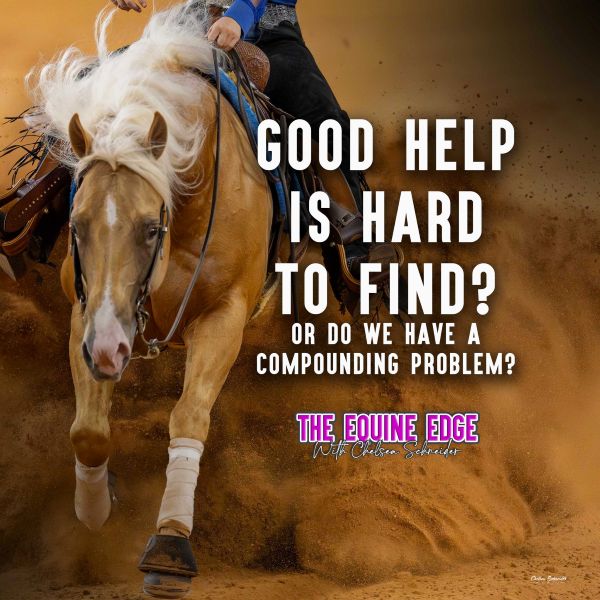
Now we follow up with Chelsea’s very popular blog as a result of response to the first piece:
Part Two: From the Trainer’s Side — Why Teaching Has Become So Hard…

After my last post, my phone hasn’t stopped ringing.
I’ve had calls from trainers across disciplines—reining, cutting, cow horse, barrel, pleasure—all saying the same thing:
“We want to teach. We want to build people. But we’re exhausted.”
So this post is the other side of the conversation—the part most people never hear.
Let’s start with a truth no one likes to say:
Turnover in this industry is brutal.
There’s a reason a well-known trainer jokes, “If you’re still here in six months, I’ll learn your name.”
That’s not cruelty. It’s survival.
People quit. People ghost. People don’t come back from lunch. People disappear after travel is paid for. People beg for opportunities and vanish the moment things get hard. When that happens over and over, trainers stop investing emotionally until someone proves they’re staying.
Teaching requires trust.
Trust requires consistency.
What trainers are actually dealing with
These are not rare, one-off situations. These are patterns:
🔺Buying plane tickets or bus tickets for new hires… who disappear after landing.
🔺People “on the way” who suddenly stop responding and never show up.
🔺Applicants begging for months for a job, then ghosting on Day One.
🔺Emergency calls that turn out to be fabricated stories—followed by empty housing and missing cash.
🔺People claiming “years of experience” who can’t bathe a horse correctly, wrap legs safely, or saddle properly.
🔺Applicants who argue when corrected instead of learning.
🔺People trained just long enough to be turned loose… then leaving for $200 more elsewhere.
When this cycle repeats, trainers don’t become cold—they become guarded. And guarded people don’t teach the way they used to.
Overselling experience is killing opportunities
This industry does not require perfection.
It requires honesty.
There is nothing wrong with saying:
“I’ve been around horses, but I haven’t worked in a professional show barn. I’m willing to learn and work hard.”
There is a problem when someone claims advanced experience and cannot perform basic tasks—or becomes defensive when corrected.
Overselling yourself doesn’t make you look capable.
It makes trainers shut down, because now they’re managing ego instead of teaching.
Ironically, the people who undersell themselves and then outperform expectations are the ones trainers invest in the most.
‼️How you apply matters more than you think
Here’s something most applicants don’t realize:
The hiring process starts the moment a job post goes up. Before anyone looks at your resume, references, or riding videos, they’re watching how you respond.
If a job post clearly states the location, job description, and contact info, and your response is:
🔹“Where are you located?”
🔹“Interested.”
🔹“Message me.”
🔹”I have experience.”
You have already moved yourself to the bottom of the list. Not because trainers are arrogant—but because initiative matters in this industry.
If you can’t:
🔸Click on the page
🔸 Read the post
🔸 Look up the location
🔸 Introduce yourself
🔸 Ask relevant questions
…then you are showing exactly how you will approach the job itself.
A proper inquiry looks like:
“Hi, my name is ____. I’m interested in the position you posted. I’m currently located in ____. I have experience with ____, and I’m looking to grow in ____. I’d love to talk if you think I might be a fit.”
That doesn’t take talent.
It takes effort. And effort is exactly what trainers are screening for.
If you comment “interested” and wait for someone to chase you—you are not ready for this job.
🔶 Housing, animals, and reality
Another hard truth:
If you are applying for an entry-level or groom position, you cannot expect a program to accommodate an entire household.
Trainer-provided housing is typically:
— shared
— basic
— designed for employees—not families
Expecting to bring:
— multiple dogs
— horses
— partners
— children
— additional animals
…while also expecting housing and a full paycheck is simply not realistic.
This is not discrimination. It is math.
Programs are already providing housing, utilities, infrastructure, and liability. There has to be a reasonable limit—especially early in a career.
‼️‼️ Be realistic about your actual experience level
Another hard truth that needs to be said out loud:
Most people drastically overestimate their level of experience and ability.
Having a horse growing up does not mean you can walk into a professional training barn with 20+ horses and function efficiently. Comfort around horses is not the same thing as competence in a fast-paced program.
One of the biggest gaps I see with new help isn’t effort — it’s time management.
When I train new employees, the most common thing I hear by lunchtime is:
“I don’t know how you got all of that done by 11 a.m.”
That’s not talent. That’s systems.
Time management is one of the most valuable skills in this industry, and it can absolutely be learned — but only if you’re honest about where you’re starting.
We live in an age where there is no excuse for not managing time:
– Set timers on your phone for walkers and jogs.
– Pre-saddle the next one or two horses.
– Think ahead about what the trainer will need next.
– Tie up stirrups, stage equipment, fill water, prep stalls before you’re scrambling.
Efficiency matters. Horses don’t wait, trainers don’t wait, and the day moves fast.
Where people get themselves in trouble is when they believe:
“I can start colts because I once rode a young horse in a pasture.”
Colt starting — and early training in general — is precious, irreplaceable time in a horse’s life. That responsibility belongs to people who have put in the years, not just the interest.
This industry, like every other profession and sport, has levels.
Not everyone is going to be Michael Jordan.
Not everyone is a first-round draft pick.
And that’s okay.
There is nothing wrong with being solid, reliable, and learning — but there is a problem when someone skips steps, overestimates their ability, and puts horses and programs at risk because of ego.
The people who succeed long-term are the ones who:
– Understand what they don’t know
– Respect the process
– Learn time management early
– And grow into responsibility instead of demanding it
🛑 Why teaching stops 🛑
Trainers are far more willing to teach someone who:
🔹 Shows up
🔹 Stays
🔹 Listens
🔹 Asks questions
🔹 Accepts correction
Than someone who:
🔺Expects immediate responsibility
🔺 Believes one year equals mastery
🔺 Wants to be riding or showing right away
🔺 Treats this like a shortcut instead of an apprenticeship
The most successful trainers today spent yearssssssssssssss learning under other programs—not months. I want to emphasize that again, years. It takes years to accurately learn a program that will give you the foundation to develop into someday your own program. 
📲 Social media matters (whether you like it or not)
This isn’t about being fake. It’s about professionalism.
Trainers look at your social media.
So do clients.
So do owners.
If your public presence suggests chaos, poor judgment, constant drama, or content that could alienate clientele, it will affect hiring decisions.
This industry is relationship-based. Image and perception matter.
The bottom line ➖
Trainers don’t stop teaching because they don’t care.
They stop teaching because:
🔺 They’ve been burned too many times
🔺 They’ve invested months into people who disappear
🔺 They’ve taken risks that backfired
🔺 They’ve watched talented people leave too early and struggle
🔺 They’re protecting their programs, staff, clients, and horses
If you want to be taught:
🔹 Show up
🔹 Stay
🔹 Undersell yourself
🔹 Work harder than expected
🔹 Be honest about where you’re starting
The fastest way to earn opportunity in this industry is humility, consistency, and initiative.
If more people understood that—on both sides—we’d lose far fewer good ones along the way.
#TheEquineEdge #theequineedgewithchelseaschneider
#ChelseaSchneiderMedia