








Good Help is Hard to Find? Or do we have a compounding problem? An EC Blog by Chelsea Schneider.

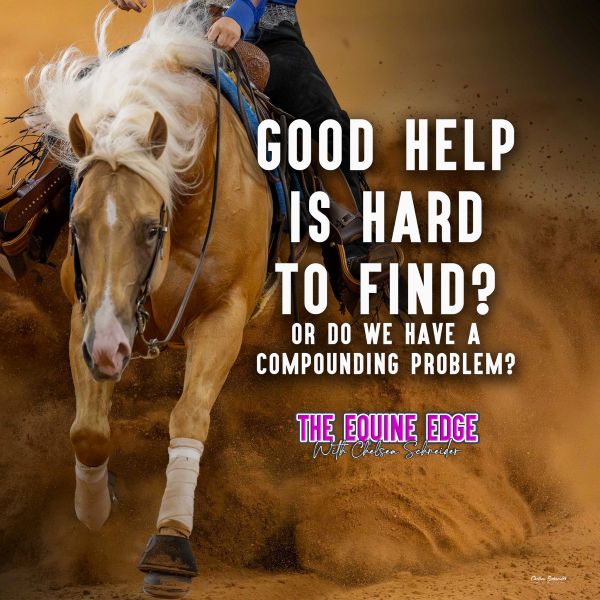
Image courtesy of Chelsea Schneider Media.
By Chelsea Schneider:
This is going to make some people uncomfortable, but it needs to be said anyway. And we know I like to talk about the uncomfortable truths —
I field 10–20 messages a day from people looking for jobs in the equine industry, primarily the Reining Industry, and I need to say something that a lot of people aren’t going to like—but it needs to be said anyway.
Most people are eliminating themselves before we ever get to pay, benefits, or burnout.
The number of messages I get that say things like “saw you tagged wut u got?” honestly blows my mind. No introduction. No explanation. No effort. I don’t care if the job is walking horses to the walker—I’m not placing you anywhere if that’s how you present yourself. I’m not asking for a college essay or perfect grammar, but a basic respectful message that tells me who you are, what you’re looking for, and what you can actually do is the bare minimum in a professional industry.
Then comes the next favorite line: “I’ve had horses since I was a kid.”
That tells me you’re possibly comfortable around horses—not that you’re qualified to work in a professional program. That’s like me saying I’ve had a barn dog my whole life so I’m ready to run a show-dog kennel. Knowing what you DON’T know matters. I would take someone all day long who says, “I’ve been around horses, I do not know a lot but I want to learn how you do things,” over someone who walks in convinced they already know it all. Teachable beats arrogant every single time. The arrogant one is the one who WILL get hurt.
And let’s clear something up—this is not “hanging out with horses all day.”
This is hard, physical, exhausting, 24/7 work. Horses don’t care if you’re sick, tired, hungover, or it’s a holiday. You know where we spent our Christmas morning? Cleaning stalls. We give the stall cleaners that day off so WE cleaned the show barn. Horses, they don’t care about your plans. Yesterday I had a horse out of the pasture at 6am. It never stops. There is no clocking in and clocking out. If you think this is a cute lifestyle job, you are in for a rude awakening.
And yes, I’m going to say it—a lot of people today are lazier than what this kind of work requires. Not everyone, but enough that it’s impossible to ignore. We are no longer dealing with a workforce raised on 12-hour physical days, grit, and “get it done no matter what.” We’re dealing with a generation that’s been taught that discomfort is a problem, not part of the job. Nap pods, mental health breaks, flexible everything—great for office jobs, not so great for horses or construction or any job where something is depending on you staying on your feet. In industries built on physical labor, urgency, and responsibility, that gap feels massive. That’s why so many of us see today’s help as lazy—because compared to the standard this work was built on, they often are. And pretending that isn’t true doesn’t help anyone.
There’s also one thing in this industry you cannot teach, and that’s feel. The people who have it are worth their weight in gold. The people who don’t—and don’t realize they don’t—are dangerous. You don’t walk into a show barn asking when you get to show when we don’t even know if you can lope off on the correct lead. Clients are not paying for someone to learn in public while making the entire program look incompetent.
That said—trainers don’t get a free pass here either.
You cannot keep saying “help is stupid” or “no one wants to work anymore” while providing zero structure. I’ve seen incredible potential get run off in days because no one bothered to explain how a large, professional facility actually functions. “Barn check” is not rolling the doors down and leaving. It’s making sure no horse is cast, nobody is tied, waterers are working, blankets are correct, horses are fed, and nobody looks off. That has to be taught. Written expectations, daily routines, and basic structure are not hand-holding—they’re leadership.
We are no longer in the “figure it out” generation, whether we like it or not. You can fight that reality, or you can adapt. And if you want people to stay, you’re going to have to teach them how you want things done.
Now for the part that really makes people uncomfortable— This is a business.
And here’s another piece of this that no one likes to talk about: clients who don’t pay their bills. Your horse trainer is not your bank. Running massive balances, constantly paying late, or expecting a trainer to “float” tens of thousands of dollars because you promise them nice horses to show is not okay. That situation puts trainers upside down fast—unable to pay their own bills, unable to pay help better, and forced into impossible decisions just to keep the doors open. If the only way your trainer gets paid is by selling your horses, something is already very wrong. If you have a pasture full of prospects but can’t pay your training bill, that’s not the trainer’s responsibility to carry. When clients don’t pay, trainers can’t pay their help, can’t improve facilities, and burn out even faster. This is how the entire system collapses—one unpaid bill at a time.
If a trainer charges $2,500 a month and you can’t afford it, that doesn’t make them greedy. It means it’s not the right fit for you. You don’t get to be mad because you can’t afford a yacht and decide yachts shouldn’t exist. Trainers have payroll, insurance, facilities, equipment, taxes—and their own futures to think about. They are allowed to make money. They have to make money. Our industry has this fairytale land surrounding it like it should be free, “Because it’s fun.” How do you think trainers can pay their help better if you don’t pay your bill?
The mindset of “but you get to be with horses all day” is exactly why good help leaves, trainers burn out, barns close, and standards drop. This industry cannot survive on romanticizing struggle.
The truth is, all of this is connected.
Help needs to show professionalism, humility, and honesty about their skill level. Trainers need to provide structure and real training. And clients need to stop treating this like a hobby that professionals should subsidize.
If we don’t fix all three, we’re going to keep losing good people on every side—and the horses will pay the price.
So I’ll ask the uncomfortable question: What do you think is hurting the industry more right now—lack of professionalism, lack of structure, or the refusal to accept that horses are a business?
Let’s talk. I want to hear your thoughts, experiences and opinions because if we do not ALL start to work together this problem will only continue to worsen.
Follow Chelsea Schneider at Facebook, or contact her at Chelsea Schneider Media, Inc