








When Swimming Fits: Tailoring Equine Rehabilitation

AdobeStock image
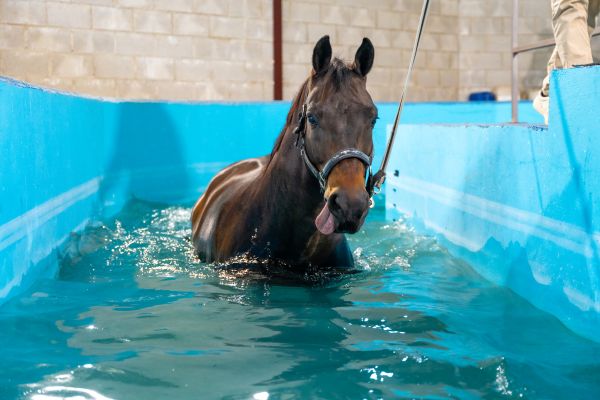
Swimming has its place in rehabilitation of equine athletes, but it might not suit every horse or every musculoskeletal problem.
Horses with cervical (neck) and thoracolumbar (back) pain underwent a rehabilitation program to determine whether swimming improved spinal mobility. Only limited changes in back mobility were observed with three weekly swimming sessions, and some horses improved more than others. These results suggest that each horse should be individually monitored during rehabilitation “to guide clinical decisions and optimize recovery,” the French veterinary researchers concluded.* These programs may or may not include aquatic therapy.
Back pain resulting in suboptimal performance is a leading cause of premature retirement in sport horses. For timely return to competition, especially at prior performance levels, injured horses require an accurate diagnosis and tailored therapeutic strategies.
Rehabilitation programs may include aquatic components, offering several therapeutic benefits:
- Reduces loading of the limbs.
- Increases range of motion.
- Minimizes joint and soft tissue stress.
- Promotes muscle recruitment and improves neuromuscular control.
- Stimulates the cardiorespiratory system and improves venous and lymphatic return.
“As such, swimming is now widely incorporated into musculoskeletal rehabilitation and conditioning protocols,” said the team.
“However, swimming requires horses to hold their heads above water, which hyperextends the cervical, thoracolumbar, and pelvic spine. This may not benefit horses with neck and back pain,” explained Kathleen Crandell, Ph.D., a nutritionist for Kentucky Equine Research.
To determine if swimming affected dorsal mobility (i.e., thoracolumbar flexion-extension) in 16 horses diagnosed with neck or back pain, horses were enrolled in a 12-week rehabilitation program that included swimming three times weekly. Four horses had cervical pathology (e.g., osteoarthritis) and 12 horses had thoracolumbar pathology (e.g., osteoarthritis, overriding or impingement of the dorsal spinous processes [kissing spine], lordosis [sway-backed], kyphosis [roach-backed], spondylosis).
Range of motion (ROM, flexion and extension) was assessed by placing inertial measurement units (IMUs) on the dorsal midline (top of the back) at the withers, the eighteenth thoracic vertebra (T18), and tubera sacrale (hip bone). IMUs are wearable, noninvasive sensors that give objective information on acceleration, rotation, movement, and movement asymmetries.
“Data analysis revealed greater thoracolumbar ROM in horses with cervical lesions than thoracolumbar lesions, but there was marked variability between individual horses,” Crandell explained. “The small number of included horses, lack of control group, and no evaluation of lateral or rotational movement, however, mean that this should be regarded as an observational study that warrants further research.”
In terms of clinical implications, decreased thoracolumbar ROM suggests stiffness and discomfort in the spine. Many horses in this study showed decreased ROM, prompting the researchers to recommend individualized monitoring of rehabilitation programs that include swimming rather than assuming a uniform benefit.
When injury sidelines a horse and forces stall confinement, rehabilitation often begins with restricted exercise. During this period, bone loss can be tempered with the addition of a bone mineralization supplement.
“Studies conducted by Kentucky Equine Research showed that supplementing with DuraPlex prevented the expected demineralization that occurs when access to free-choice exercise is restricted or during stall rest due to injury,” Crandell shared. DuraPlex is not available in some regions, so consider another research-proven bone supplement.
*Pécresse, B., C. Moiroud, S. Hanne-Poujade, C. Hatrisse, E. de Azevedo, V. Coudry, S. Jacquet, F. Audigie, and H. Chateau. 2025. Group and individual changes in spinal mobility during a 12-week rehabilitation program including swimming in horses with axial musculoskeletal lesions. Animals (Basel) 30;16(1):103.