







Side Effects of SGLT2 Inhibitors (-flozin drugs) in Horses are Avoidable

Photo credit: Brittany Vermeer.
Eleanor M. Kellon, VMD
There is no question that the -flozin drugs, primarily ertugliflozin and canagliflozin at this time, are a very potent tool in the war against metabolic syndrome and high insulin.
They work by blocking the reuptake of glucose, which is initially filtered out of the blood by the kidneys then reabsorbed. In people, this alone can lead to low blood sugar, but that’s not an issue for horses. Instead, their problems are related to the consequences of losing all that glucose/sugar.
Urine that is high in sugar will hold more water, leading to higher urine volumes and potential dehydration. This is magnified by the fact that many horses do not receive enough salt and are already somewhat dehydrated. The average size horse should get a minimum of 1 oz/day, all year, to cover losses, plus another 1 oz per hour worked, and also have it available free-choice.
The dehydration can also lead to kidney damage. This is a greater danger with a horse having a history of extensive NSAID use (bute, Banamine, Equioxx, etc.). The FDA has warned against using -flozins and NSAIDs at the same time.
The other major risk is hypertriglyceridemia–high triglycerides (TGs) in the blood. The loss of glucose, the body’s premier fuel and only fuel for the brain, causes an energy crisis. As a result, the body increases output of triglycerides. The same thing happens after exercise and during underfeeding or starvation. Almost all horses on the -flozins develop elevated TGs.
If these are not efficiently burned, or the release of TGs overwhelms the capacity to use them, they will accumulate in the liver and cause elevated liver enzymes. Extreme cases show depression, poor appetite, even death. This is avoidable.
The answer is not to stop the drug, as so many do. That will only put the horse right back in the same condition with insulin. The answer is correct diet and supplementation.
At the ECIR Group, we were using canagliflozin for almost two years until we realized what was going on when one member’s horse was ill enough to be hospitalized. This is not the same thing as the hyperlipidemia of ponies, minis, and donkeys in that they respond very quickly to treatment and rarely stop eating. This horse had a 2,000% elevation of TGs, but responded quickly.
Carnitine is the key to getting fats into the mitochondria to be burned. Since it is synthesized from the two most commonly deficient amino acids, lysine and methionine, it should be no surprise that supplies may not be up to the task. We suggest supplementing all horses on -flozins that start to show TG elevations with 1 gram of carnitine per 100 lbs body weight.
“Fat burns on the flame of carbohydrates” is a famous principle in metabolism. Fat can only be burned inside the mitochondria in the Kreb’s (aka TCA) cycle. Some of the intermediates in that cycle can only come from glucose. The most critical intermediate is oxaloacetate, which starts and ends the cycle. To guard against shortages, we supplement with 10 grams of glycine per 100 lbs, the most palatable of the amino acids that can be converted to oxaloacetate. Any biochemistry fans should view this illustration.
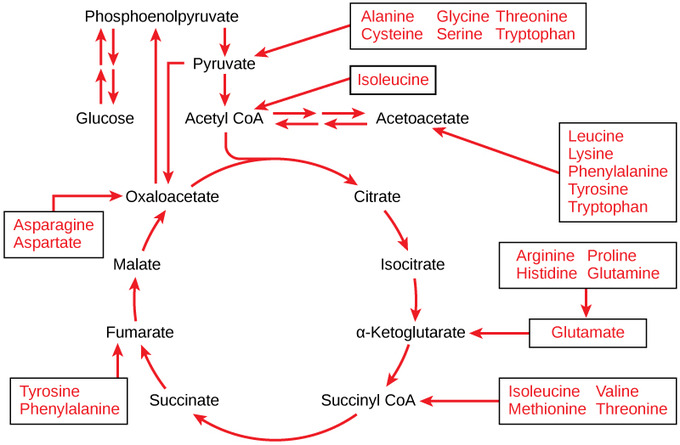
Glycine can also be converted to pyruvate and back to glucose, which brings us to the base diet. With all that glucose loss, it needs adjustment:
- Hay up to 12% ESC + starch, free-choice
- Do not soak hay
- 1 lb beet pulp per 500 lbs body weight daily for easily fermentable fiber
- If protein is under 10%, supplement with soybean meal to reach that benchmark. Protein contributes to gluconeogenesis and intermediates for the Kreb’s cycle.
Problems with -flozins have been virtually nonexistent among our members since instituting these measures.
Further reading:
Kellon EM, Gustafson KM. Use of the SGLT2 inhibitor canagliflozin for control of refractory equine hyperinsulinemia and laminitis. Open Veterinary Journal, (2022), Vol. 12(4): 511-518 DOI: 10.5455/OVJ.2022.v12.i4.14 https://pubmed.ncbi.nlm.nih.gov/36118716/
Kellon EM, Gustafson KM. Hypertriglyceridemia in equines with refractory hyperinsulinemia treated with SGLT2 inhibitors. Open Veterinary Journal, (2023), Vol. 13(3): 365-375 DOI: 10.5455/OVJ.2023.v13.i3.14 https://pubmed.ncbi.nlm.nih.gov/37026076/
Treatment of EMS and Insulin Resistance (IR) in PPID. https://www.ecirhorse.org/treatment-EMS.php
About ECIR Group Inc.
Started in 1999, the ECIR Group is the largest field-trial database for PPID and EMS in the world and provides the latest research, diagnosis, and treatment information, in addition to dietary recommendations for horses with these conditions. Even universities do not and cannot compile and follow long term as many in-depth case histories of PPID/EMS horses as the ECIR Group.
In 2013 the Equine Cushing’s and Insulin Resistance Group Inc., an Arizona nonprofit corporation, was approved as a 501(c)3 public charity. Contributions and grants support ongoing research, education, and awareness of Equine Cushing’s Disease/PPID and EMS.