








Prevent emergencies from becoming disasters. Whether it’s a fire, tornado or flood, having a plan can prevent or reduce the impacts of these events. Prepare for events around your house and your barn as well.
When building new structures or remodeling old ones, think about emergency preparation in the design of your barn and other facilities.
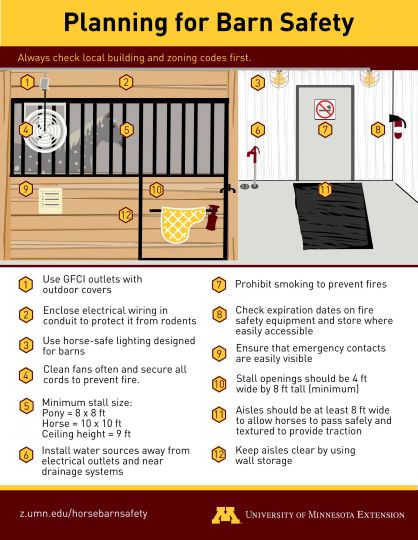
Barn designs should include
- Multiple exits
- Use of curtains or firewalls
- Fire-resistant materials
- Good ventilation
- Hay storage separate from animal housing
- Easy access to water
- Quarantine areas
- Located out of flood plain and other wet areas
- Facility and ground cleanliness
General preparation
Consider what events may be the most devastating for your barn. Planning for these events will help prepare you for other events. For example, you can use a fire evacuation plan for tornadoes and floods.
Keep these items in or near your home and at an off-site location.
- Human first aid kit
- Emergency kit with food and water for three days
- Important paperwork
- Photos and written descriptions of all horses
- Extra halters and lead ropes
- Generator with enough fuel for three days
- Working flashlights
- Battery-powered radio
For more details on preparing your house, contact the at 612-871-7676.
Emergency contacts
Put emergency contact information in an easy-to-find location and make sure that family, employees and clients know where it is. Contacts should include first responders, a veterinarian, your contact information, and others willing to assist during an emergency.
Have a horse first aid kit
You can purchase pre-assembled horse first aid kits. Learn how to create and use a basic first aid kit for your horse.
Learn about frightened animal behavior
Human safety is always the first priority. This includes the horse owner, family members, employees, boarders, visitors and you.
Frightened animals are unpredictable. Even the gentlest horse can become dangerous when frightened. Take specific actions to avoid getting in harm’s way. Learn more about unwanted behaviors and vices in horses.
Identify your horses
Identifying horses is valuable if a horse is lost or stolen. If you have a horse without identifiable markings, this is particularly important. Identifying methods are a personal preference but may also be a breed requirement. Registered horses may already have one or more of the following in place.
Permanent identifiers
- Photographs and written descriptions
- Brands
- Tattoos
- Microchips
Temporary identifiers
- Washable paint
- Etched hooves
- Luggage tag with contact information braided into the mane
- Pastern bands
Goals of an evacuation plan
- The plan quickly and safely moves animals and people out of the facility.
- Everyone engaged in the facility knows the plan and can carry it out without the owner.
- The plan brings awareness of potential emergencies and barn problems to horse owners.
- The plan is written out and easily accessible to others.
- All buildings must have multiple unblocked exits that people and animals can use.
Plans for an evacuation like a flood may differ from plans for a fire when there is less time.
Here are the questions your plan should answer:
How will each horse be removed from the barn?
- Will they be led individually or herded?
- In what order?
- Can they be herded out the door to a holding pen? It may not be possible or safe to put a halter on a panicked horse.
Where will you keep spare halters and lead ropes?
Having spare halters away from the barn can be beneficial (as during a fire), especially if there are large numbers of horses on the property.
Are there horses that need to be handled differently?
Examples include stallions, foals or elderly horses.
Where will the horses go if the barn is damaged?
- Ideally, put horses in a safe paddock away from the barn.
- During a fire, place horses far from the burning building to avoid illness from breathing in smoke.
- Is there space to separate horses (such as stallions)?
- During an emergency, it’s common for a frightened or confused horse to try and return back to its stall, where it feels the safest.
- Practice using all barn exits.
Will you be able to get food and water to the holding area?
This applies if they need to stay there for an extended time.
Can you trailer the horses if necessary?
- Is there access to a functional truck and trailer?
- Will the horses easily load?
Has everyone involved in the horse facility practiced the evacuation plan?
A lot can be learned from practicing an evacuation plan. From practicing you can improve your plan as necessary.
Do you know your neighbors or other horse owners in the area?
Neighboring horse owners can be a resource during an emergency.