






UC Davis Researchers Identify Genetic Cause for Fatal Neurologic Disease in Foals

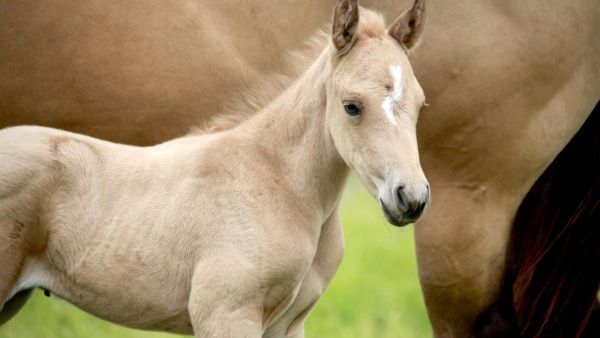
Learn more: https://www.vetmed.ucdavis.edu/news/uc-davis-researchers-identify-genetic-cause-fatal-neurologic-disease-foals.
Photo: UC Davis School of Veterinary Medicine.
Researchers at the UC Davis Weill School of Veterinary Medicine, led by Dr. Carrie Finno and graduate student Briana Brown, have reported the genetic cause of a fatal neurologic disease, equine juvenile spinocerebellar ataxia (EJSCA), in American Quarter Horse foals. A genetic test is available through the UC Davis Veterinary Genetics Laboratory (VGL).
Foals with EJSCA display incoordination within the first month of life. The disease damages axons, the nerve fibers that allow the brain and spinal cord to communicate. As these pathways deteriorate, communication is interrupted or lost, so foals do not know where their legs are in relation to the ground, leading to issues with movement and balance. The disease progresses rapidly, causing severe weakness in the hind limbs and difficulty standing. There is no treatment or cure, and affected foals are humanely euthanized.
“This is one of the most devastating diseases that I have seen in 20 years as an equine veterinarian,” said Finno. “These foals progress from looking completely normal, to slightly uncoordinated, to unable to stand in a matter of days. It is devastating to their owners and breeders.”
Research performed at UC Davis identified an autosomal recessive mode of inheritance, meaning that a foal needs two copies of the causative variant to become affected. Parents with one copy of the EJSCA variant (i.e. carriers) are not affected but can pass the disease variant on to their offspring.
Using whole genome sequencing, the UC Davis team identified the disease-causing variant in a non-coding region of the ferredoxin reductase (FDXR) gene. The effects of non-coding variants (which are not normally involved in making the protein) are difficult to prove, and a variety of experimental approaches were necessary to demonstrate that this is cause of EJSCA.
The FDXR variant leads to the incorporation of a segment of DNA that is not normally translated into protein, resulting in an altered version. Consequently, affected foals exhibit lower levels of FDXR protein than unaffected foals. The FDXR protein sequence is similar between horses and humans, and known FDXR genetic variants result in similar neurologic signs in people.
The first case of EJSCA was identified in 2020 in a filly named “Curly Sue” at Coyote Rock Ranch. Sue Hagerty, Director of Operations, and owner Penelope Knight reached out to Dr. Finno’s lab with concerns about another disease, equine neuroxonal dystrophy (eNAD). The team worked with Dr. Ana Pacheco at the Carleson College of Veterinary Medicine, Oregon State University, to determine that Curly Sue did not appear to have eNAD. She had something that they had never seen before.
“While the loss of Curly Sue was tragic, we wanted something positive to come from our heartache,” said Hagerty. “We were confident that if anyone could identify the cause, it was Dr. Finno.”
“Since it is such a devastating disease, there was an urgent need to identify the cause,” said Finno. “Fortunately, we were able to secure funding from the UC Davis Center for Equine Health (CEH) and perform the genetic investigation. This highlights the strength of the UC Davis CEH program and how it can rapidly solve research questions for horses and their owners.”
Testing in more than 1,000 randomly selected Quarter Horses identified 25 carriers, indicating that the variant exists at a comparatively low frequency (0.012) in the overall population. It was not observed in more than 25 other breeds tested. Testing in additional Quarter Horses and other breeds was supported by the VGL.
“We worked as quickly as we could to identify the genetic cause for the disease,” said Finno. “It wasn’t as straightforward as I had hoped, but we are pleased to be able to offer a test for EJSCA so breeders can make informed breeding decisions.”
The American Quarter Horse is the most popular horse breed in North America, with more than 7 million horses registered worldwide. The low frequency of the variant in the breed, as well as the fact that all affected foals to date trace back to one prominent sire, suggest that this is a new genetic variant.
Breeders can use the UC Davis test to avoid producing affected foals. The test is simple and requires 20-30 hairs from potential parents. Breedings between two carriers have a 25% chance of producing an EJSCA-affected foal.
“We are grateful that Dr. Finno’s team shared their discovery early with the VGL, allowing us to develop a test for American Quarter Horse breeders,” said VGL Director Dr. Rebecca Bellone. “The test gives breeders a tool to prevent producing affected foals by ensuring carriers are not bred together.”
Dr. Finno’s graduate student, Briana Brown, performed many of the experiments for this study. She was subsequently accepted into the DVM program at the UC Davis Weill School of Veterinary Medicine and recently finished her first year of training. Her goal is to become an equine veterinarian.
The discovery of the EJSCA variant marks the first non-coding neurologic genetic variant identified in horses and the first known genetic cause of an equine degenerative axon disease. It also represents a spontaneous disease model to study FDXR-related conditions in humans.
About the UC Davis Center for Equine Health
As part of the UC Davis Weill School of Veterinary Medicine, the Center for Equine Health is dedicated to advancing the health, welfare, performance and veterinary care of horses through research, education and public service. The center proves academic leadership and serves as the organizational umbrella under which equine research is funded and conducted at the UC Davis Weill School of Veterinary Medicine. For more information about the Center for Equine Health, please visit https://ceh.vetmed.ucdavis.edu/.