








Patience or Procedure? New Insights on Hock OCD in Foals

Foals diagnosed with osteochondritis dissecans of the hock may not need surgery because most cases spontaneously resolve by six months of age, according to a new study.
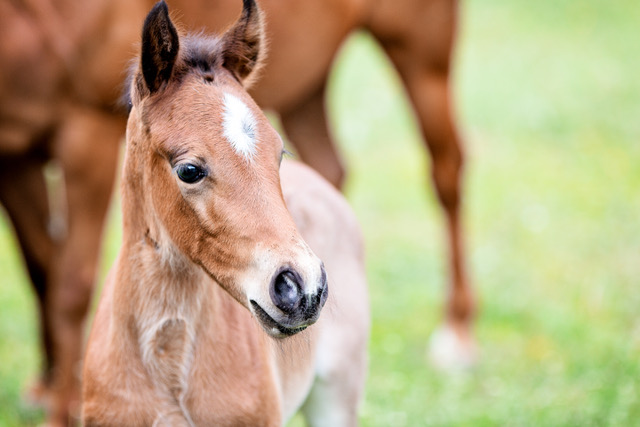
AdobeStock image
By Kentucky Equine Research Staff:
Foals diagnosed with osteochondrosis of the hock may not need surgery because most cases spontaneously resolve by six months of age, according to a new study.* Identifying the environmental or nutritional causes behind spontaneous resolution could significantly improve nonsurgical healing rates.
Osteochondrosis is a developmental orthopedic disease believed to be caused by a failure of endochondral ossification. This means the normal process by which cartilage is replaced by bone during growth is disrupted. On radiograph, osteochondrosis is diagnosed due to the presence of flattening or divots in the normal contour of the surface of the bone within the joint.
While the terms are often used interchangeably, osteochondrosis refers to the initial bone-contour abnormality, which can either heal or progress into osteochondritis dissecans (OCD), the more serious condition.
“A proportion of these osteochondrosis lesions resolve on their own as foals continues to grow. Others will advance to OCD, characterized by the formation of cartilage and bone flaps that may break off and float freely within the joint causing inflammation,” explained Kathleen Crandell, Ph.D., a nutritionist for Kentucky Equine Research.
Genetics, biomechanical forces on the musculoskeletal system, rapid growth, and nutritional factors such as an imbalance in nutrients may all play a role in osteochondrosis and OCD.
“Providing a balanced nutritional profile of energy and essential nutrients to the growing horse is key,” asserted Crandell.
Nutritional factors such as excessive caloric intake, particularly from nonstructural carbohydrates, may spur rapid growth or influence faulty development of cartilage cellular matrix. Additionally, too much, too little, or an imbalance of minerals can negatively affect skeletal development.
To better understand osteochondrosis and the role of biomechanical forces in its development and resolution, veterinary surgeons followed a group of 148 foals from two months of age to 12 months of age. Researchers took radiographs of the foals every two months, and videos were recorded for two hours each week during the same time to determine the amount of time they spent trotting or pacing.
This study revealed that osteochondral lesions were highly prevalent in this population of Standardbreds. At two months of age, 70% of foals were diagnosed with one or more osteochondrosis lesions in the hock joint. By twelve months of age, however, only 22% of foals still had osteochondrosis lesions, meaning that most lesions resolved on their own. Delving deeper into the data, the surgeons found that most osteochondral lesions (85%) healed by six months of age, and only 18% progressed to OCD.
“Once an OCD fragment was diagnosed, however, no healing occurred. Those OCD lesions were noted as early as four months of age, but most commonly by six months of age,” Crandell said.
Video-monitoring of the foals’ activity revealed that foals spent most (80%) of their time eating and standing quietly and less than 2% of their time trotting or pacing. The surgeons therefore concluded that “it seems unlikely that direct mechanical effects of either gait played a role in the healing (or otherwise) of osteochondrosis lesions in this cohort, but this cannot be completely ruled out.”
The researchers also stated that the most important message from this study related to surgical intervention. They recommended the following:
- If OCD fragmentation is present: Healing is no longer possible. Early surgical removal (prior to 12 months of age) is recommended.
- If only osteochondral lesions exist (no fragments): Spontaneous healing is likely. Delaying surgery until 12 months of age is reasonable, provided periodic radiographs monitor the progress.
Practical Nutritional Help
What can help? According to Crandell, DuraPlex and Triacton are nutritional supplements that feature an array of bone-building nutrients to support sound skeletal development and maintenance when a foal has forced confinement, when entering a training environment, or during critical growth phases when lesions are most likely to appear.
“This study also highlights how early bone health can be affected. Owners and breeders should be cognizant of not only the foal’s nutrition and growth rate right from birth but also the nutrition of the dam during pregnancy,” Crandell emphasized. “Studies have shown that the diet of the mare can have an influence in the developing fetus on the incidence of developmental orthopedic diseases after parturition.”
*McCoy, A.M., C.T. Lopp-Schurter, R.C. Bishop, A. Narotsky, K. Grogger, and A.M. Kemper. 2026. Natural progression of tarsal osteochondrosis in Standardbred pacers and trotters. Veterinary Surgery:70073.