








American Horse Council Letter to the University of California Board of Regents

From the American Horse Council:
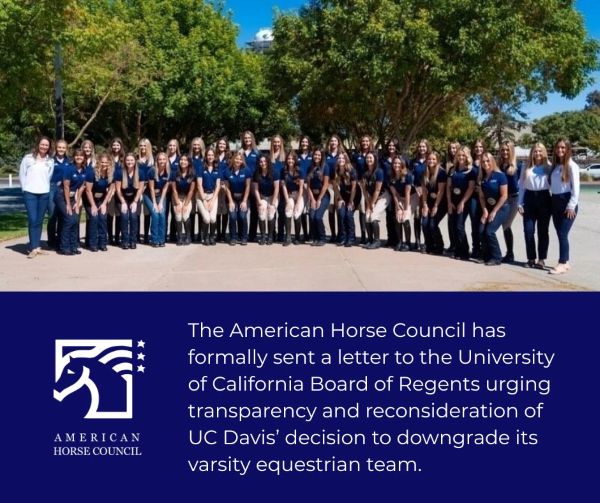
The American Horse Council has formally sent a letter to the University of California Board of Regents urging transparency and reconsideration of UC Davis’ decision to downgrade its varsity equestrian team.
As a premier land-grant university, UC Davis has long celebrated its agricultural roots and its leadership in animal science, veterinary medicine, and rural workforce development. Equestrian is more than a sport — it is a direct pipeline to careers in agriculture, animal health, and the equine industry.
The UC Davis equestrian program is nationally recognized, well-supported by donors, and provides rare Division I opportunities for women on the West Coast. Downgrading the program midseason raises important questions:
• Was transparent, sport-by-sport financial data shared?
• Were donor commitments fully considered?
• How does this decision align with the university’s agricultural mission?
• What message does this send about the stability of equestrian as an NCAA Emerging Sport for Women?
Managing a 1,200-pound partner teaches leadership, communication, logistics, budgeting, and calm decision-making under pressure, all skills that translate directly into professional success.
We believe institutions that proudly embrace their agricultural identity should stand behind programs that help fulfill that mission.
We respectfully urge the Regents to require full transparency, consider donor engagement, and reevaluate this decision in the best interest of student-athletes, women’s athletics, and California’s agricultural workforce.
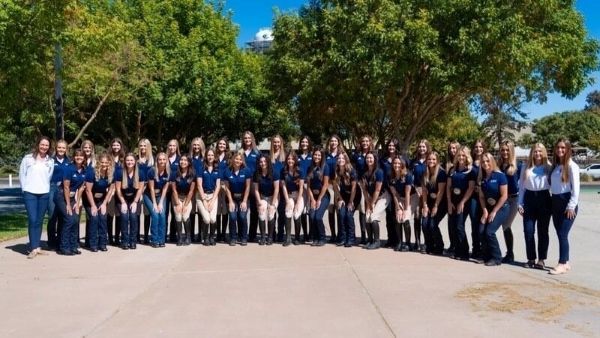
Photo credit: UC Davis
February 3, 2026
University of California Board of Regents
University of California
1111 Franklin Street, 12th Floor
Oakland, CA 94607
Dear Regents:
“Horse hockey” is a term every Regent of a land‑grant agricultural university ought to recognize as shorthand for nonsense, and it aptly captures UC Davis’ recent decision to downgrade its varsity equestrian team while elevating STUNT, a competitive cheer discipline, to varsity status.
Our point is not to denigrate competitive cheer but to add vital context to the decision. UC Davis has said it is “aligning resources” in Division I athletics, following internal and external analyses, and the Athletics Department has specifically cited competitive alignment, student-athlete participation, academic performance, Title IX gender-equity obligations, and financial sustainability as the rationales.
That explanation disregards the university’s history and culture. UC Davis is a premier land‑grant institution that proudly promotes its agricultural and animal science programs. Its graduates go on to leadership roles in animal health, biotech, veterinary medicine, the livestock and equine industries, agricultural education, and rural community life. Equestrian student‑athletes are disproportionately drawn from, and return to, these sectors, and UC Davis routinely cites this pipeline as evidence that it is fulfilling its land‑grant mission.
There is good reason for that. The university’s equestrian program remains nationally recognized for its competitive success and donor support. Beyond that, equestrian is a lifelong sport and a powerful training ground for women.
Managing a 1,200‑pound partner emphasizes the importance of clear communication, negotiation, risk assessment, and calm decision‑making under pressure. Skills such as organizing teams, coordinating travel and competitions, and working with coaches, veterinarians, and barn managers help build real‑world experience in logistics, budgeting, leadership, and collaborative problem‑solving.
As one of the few Division I equestrian programs on the West Coast, UC Davis provides a rare opportunity for riders and future agriculture professionals. If an established agricultural university can quietly downgrade equestrian midseason despite robust donor support, what does that say about the stability of equestrian as an NCAA Emerging Sport for Women? It weakens the case that these programs are secure investments in women’s athletics and in rural and agricultural career pathways.
Another issue is the lack of transparency. UC Davis has not provided apples‑to‑apples data on the cost per student‑athlete in equestrian compared with other Olympic, non‑revenue, or roster‑heavy sports. Since the university relies heavily on institutional support and student fees to fund 25 varsity sports, it is fair to ask: What is the all‑in cost per equestrian athlete compared with those in other sports? Were donors’ offers to bridge funding for equestrian fully incorporated into that analysis? Did athletics leaders factor in graduation and GPA outcomes or downstream career placement? Did the administration consider the school’s agricultural mission? Even after a petition opposing the change had garnered more than 14,000 signatures, the university “did not respond to a list of follow‑up questions,” as student outlet Abridged reported.
UC Davis likes to celebrate its “Aggie” identity and land grant purpose in marketing materials. Having equestrian as a fully supported varsity sport has been one of the clearest ways to actually live that identity. You, as Regents, together with campus leadership, should ask whether walking away from an equestrian program is consistent with the university’s obligation to California’s agriculture workforce and its professed commitment to genuine opportunities for women in sport. If UC Davis chooses to downgrade the very program that helped develop Olympic silver medalist Gina Miles, who trained at the UC Davis Equestrian Center and rode with the UC Davis Eventing Team, will there be another Aggie Olympic equestrian medalist in the future, or is the university content to let that be a once-in-a-generation accomplishment?”
We urge you to exercise your oversight role, require transparent, sport‑by‑sport financial and outcomes data, fully consider donor participation, and reevaluate this shortsighted decision. UC Davis and the broader University of California system can and should do better by its equestrian student‑athletes, its agricultural mission, and the communities they were created to serve.
Sincerely,
Julie M. Broadway
Julie M. Broadway, CAE®
President, American Horse Council &
American Horse Council Foundation
CC:
Parents’ Group, UC Davis Equestrian Team California State Horsemen’s Association
American Horse Council Foundation 1775 Tysons Blvd.
5th Floor, Suite 4110
McLean, VA 22102
info@horsecouncil.org