







Winter Tips For Your Horse — Straight from the DVM

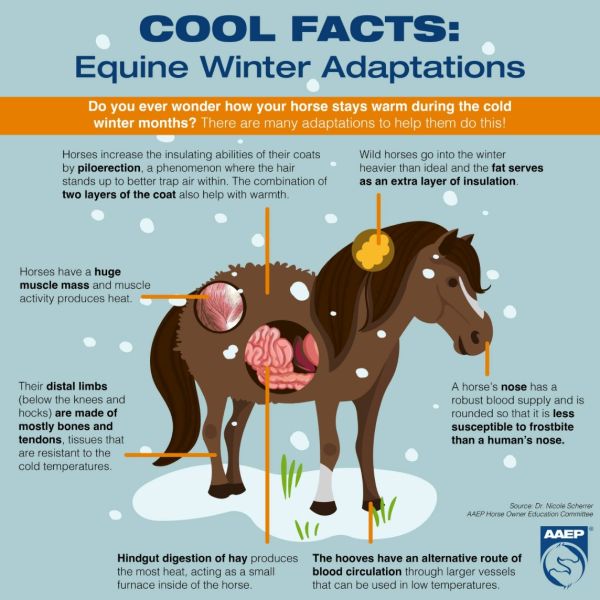
Image credit: AAEP
By Brian S. Burks, DVM, Diplomate, ABVP, Board Certified in Equine Practice
There are several factors to consider for winterizing your horses. Food, blanketing, shelter, turn out, and exercise should be evaluated to ensure that your horse can thrive during the winter, as well as the warmer months.
Food is the most important factor. The process of roughage digestion creates heat. So keeping hay in front of them not only helps to prevent gastric ulceration, but generates heat to keep them warm in cold temperatures. Increasing caloric intake through roughage provides longer lasting heat from fermentation in the colon. Forage also minimizes the carbohydrate load that can lead to intestinal upsets or laminitis. Horses do handle lower temperatures better than humans since their body mass is much greater, but their skin is only 2.5 times that of ours- so they have less surface area to lose heat.
Well-fed horses often have a good layer of fat- this layer is more important than their coat. Fat is three times better at insulating compared to other tissues- i.e., skin and hair. Make sure that your horse is not underweight going into winter.
Especially for underweight horses, make sure to have a veterinarian check their teeth, do a fecal egg count, and look for evidence of pain, all of which can cause weight loss. Underweight horses may also have Equine Cushing’s Disease.
On the other hand, overweight horses may lose weight in cooler temperatures, even without reducing food intake. Leaving off the blanket can help burn calories in such horses as they produce heat to stay warm.

A few words about clipping your horse are essential. If you intend to work your horse hard, you will probably need some sort of clip- mostly a trace clip, leaving hair on the limbs and neck. They will get too hot when worked with a long coat. This means that your horse will need to be blanketed. Unclipped horses can tolerate temperatures down to 14F. If the temperature is around 14 degrees or below, you might either add extra hay or add a blanket.
Blankets, however, present some problems. First, remember to take the blanket off to check for any problems underneath, such as sores and mud. Also check to be sure there is no weight loss hidden by the blanket and winter hair. You will need to feel the horse with your hands. Second, be sure that the straps are used properly to help mitigate any danger of getting a limb stuck on the wrong side of the strap.
Horses raise their winter coat to stay warm, and blankets limit this response. So does being wet. By raising their hair, the trapped air provides extra insulation. If your horse is shivering, you can be sure he is pretty cold. On the contrary, if the hair coat is flat, your horse is not cold.
When it is raining, snowing, and blowing, it is harder for a horse to stay warm; a blanket is advisable. Being wet and cold is obviously not a good thing. Your horse cannot take in enough roughage to generate enough heat to stay warm. You might think to feed extra grain, but remember that extra grain will predispose your horse to digestive disorders. If you are going to increase the grain ration, adding more times per day, i.e. 4 feedings instead of two, is advisable.
Shelter is something everyone wants for their horses. But is shelter bad? Closing horses into a barn warms the air but also creates humidity. Ammonia levels may increase due to urine. This can damage the fragile epithelial lining of the respiratory tract. If you can smell ammonia, the levels are too high. Getting horses out of direct drafts is helpful, but there needs to be enough air exchange- several times per hour- to keep down odors. Dry, cold, fresh air is comfortable for horses. Most horses will choose to remain outside, even in the most inclement conditions. They may choose to stay out in a storm, with their haunches to the wind. Regardless, shelter should be provided, to give horses the option of housing or not.
The main concern with turnout is icy conditions, particularly for stabled horses. They may smell the fresh air and run around, falling on the ice, leading to injury. The best way to manage this is continual turnout, or at least regular turnout. Horses can also be ridden prior to turnout, making them a bit tired and less likely to hurt themselves.
Prepare for mud. Create a sacrifice area and use gravel in heavily trod areas such as gateways and water troughs.
Hay should be stored separately, if possible, to minimize exposure to dust, and also to reduce fire hazards. Air exchange also decreases the number of pathogens, molds, and endotoxins; vaccination against influenza and rhinopneumonitis and strangles are advised. This, along with a well-ventilated barn can help reduce disorders of the respiratory tract.
While horses handle the out-of-doors very well, outdoor shelter should be provided as a wind break, and a way to get out of the rain and snow. The solid side of the building should be toward the prevailing wind, with walls eight feet in height. Check to make sure your buildings are in good repair for the winter with a roof in good repair and no nails sticking out anywhere.
What about working your horse during the cold winter months? Due to the length of the upper airway, from the nostrils to the lungs, air gets warmed before it reaches the lungs. This means that very cold temperatures below zero can be tolerated much more readily than in humans where the cold temperature will damage the lung tissue.
Exercise during the winter keeps them in shape for the coming spring and summer months and aids intestinal motility. You may want to consider using shoes with studs or borium when riding in the snow, as these will give more traction when ice is encountered. Snow pads or vegetable shortening can be used to prevent ice-balls while turned out or being ridden. If you are not planning to ride, it may be best to remove the shoes to prevent ice/snow build up on the sole. Metal bits may also be cold in your horse’s mouth. When you are done riding, do not put your horse away wet. In the cold, sweat will make your horse colder; cover him up and walk until dry. Exercise also encourages water intake. Tepid water should be provided.
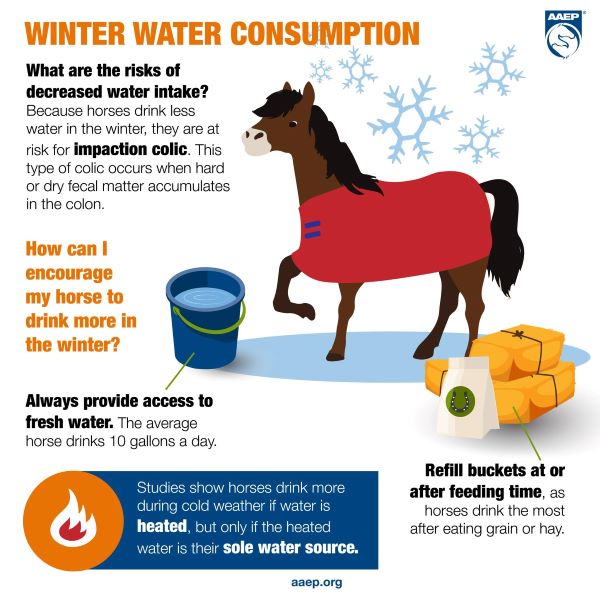
Image credit: AAEP
Riding in deep snow can be exhilarating, but it is hard work for the horse and can be rough on the tendon and ligamentous structures. Protect those structures by going easy through the snow; you do not want to cause a bowed tendon.
Proper warm up and cool down are essential. Walking for 10-15 minutes is an effective warm up. Sweating horses, however, get their core heat pulled out due to evaporation, making them colder. Using a blanket or cooler until dry is recommended. Walking your horse until dry will allow a gradual cool down that prevents skin and muscle cramping. Once your horse is dry, the blanket can be removed, unless the horse has been clipped.
Remember to monitor water consumption. Lack of access to water, through frozen buckets, is the number one cause of colic in the winter. Horses prefer lukewarm water. Putting hot water into buckets seems to make the water freeze faster, so this is probably not a good idea. Lack of water consumption can lead to impaction colic. Heated buckets and tubs can present a fire risk and are probably best confined to outside use. Be sure that any water heating system is grounded; use of a ground fault interrupter is essential. Horses can detect low voltages and may refuse to drink. Loose wires should be covered with PVC pipes or kept out of the stall to prevent your horse from chewing them.
Adding several tablespoons of salt to your horse’s hay or grain several times per day can help encourage water consumption.
Additionally, good dental care ensures that your horse can maximize nutrition gained from the hay and grain. Teeth should be checked at least annually; more if your horse is older or has dental issues. Deworming is also important. Cyathostomes (small strongyles) imbed themselves in the intestinal wall during very cold or very hot weather. Massive entrance or exit of these worms can cause severe colitis, or intestinal inflammation, and diarrhea. Consult with your veterinarian regarding a proper deworming program.
In general, horses do well when they can move about and have lots of fresh air. Moving keeps muscles limber and helps to keep the digestive tract moving. It also promotes respiratory health. Taking a few simple precautions can help your horse healthy during the cold winter months.
For regular, educational articles from Dr. Brian Burks, follow Fox Run Equine Center on Facebook:
https://www.facebook.com/FoxRunEquineCenter
Dr. Brian Burks is the owner of Fox Run Equine Center, a 24-hour medical-surgical center near Pittsburgh, Pennsylvania. The Center has been in western PA since 1984 and remains the premier equine hospital serving the tri-state area. Dr. Burks was an intern and then a resident in equine internal medicine. He is a Board Certified Equine Specialist, by the American Board of Veterinary Practitioners.