








The Power of Fascia: Supporting Elastic, Efficient Movement

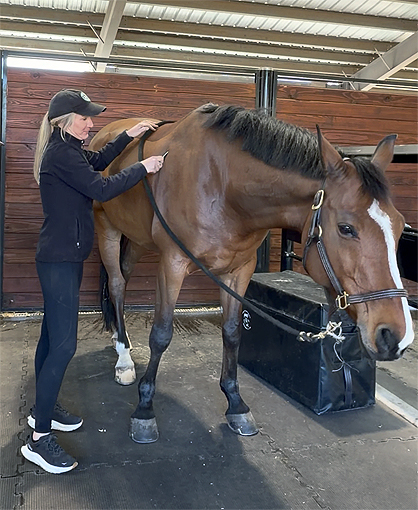
All images courtesy of Farmhouse Chiropractic.
Dr. Jillian Johnson of Farmhouse Chiropractic at World Equestrian Center – Ocala has written a brilliant three-part series exclusively for The Equine Chronicle to benefit the equine athlete and owner — below find part three, and at the bottom, you’ll find links to the first two articles:
The Power of Fascia: Supporting Elastic, Efficient Movement
Every rider has felt it — the horse who is fit, well trained, and seemingly sound, yet still feels resistant, uneven, or harder to put together. Despite thoughtful training and conditioning, something in the system doesn’t feel like it’s organizing as easily as it should. Often, the missing piece isn’t more work. It’s more freedom.
That freedom frequently comes down to fascia. While fascia is often described simply as connective tissue, that only tells part of the story. It is also a highly sensitive, communicative system that constantly sends information to the brain about load, safety, and movement. In many ways, fascia functions as the body’s internal sensor network, influencing posture, coordination, and how smoothly movement is coordinated throughout the system.
Anatomically, fascia forms layers between the skin, muscles, and deeper structures, allowing tissues to glide as the body moves. But beyond structure, fascia is increasingly recognized as one of the body’s most sensory-rich tissues. It plays a major role in how the brain interprets position, tension, and movement quality. When fascia is healthy, it supports smooth coordination and efficient transfer of motion. When it’s irritated or protective, it can contribute to stiffness, guarded movement, and recurring compensation patterns.
Fascia can also be one reason certain movement patterns are hard to change. When the body has adapted to a particular way of moving — even if it’s not ideal — that pattern can begin to feel “safe” to the system. Fascia helps reinforce those patterns by continuously communicating with the nervous system about stability and perceived threat. In this way, restriction isn’t just a mechanical issue — it can also be a learned one.
When fascia is stuck in a protective state, it behaves less like elastic fabric and more like glue, limiting glide between layers and reducing the body’s ability to move efficiently. Over time, this can show up as stiffness, asymmetries from side to side, uneven transitions, or a gradual loss of elasticity that affects performance consistency.
The good news is that fascia is adaptable. With the right input, it can shift from a protective state into a more receptive one. Thoughtful hands-on work, improved motion, and nervous system regulation can all help signal to the body that it’s safe to soften, reorganize, and explore new patterns. Instead of forcing change, this approach invites change — allowing healthier movement options to become available and sustainable over time.
This isn’t just a horse conversation. Riders are athletes, too, and tension patterns influence the partnership in different ways. Sometimes horses mirror the rider’s tension, and other times they compensate in the opposite direction to stabilize the team. Supporting one side of the partnership without the other can limit how much change the system can hold.
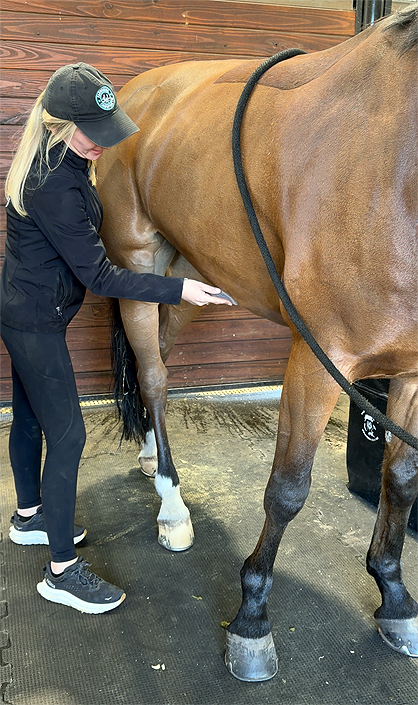
At Farmhouse, we approach fascia as part of a larger performance system. When the body is bracing, movement doesn’t coordinate as efficiently, and adaptability is reduced. That’s why our work blends precise chiropractic care, advanced bodywork, targeted recovery modalities, and nervous system–based techniques — not just to change tissue in the moment, but to help the system reset so healthier patterns can take hold. By identifying early compensation patterns and reducing interference before they compound, we help horses maintain the fluidity that supports both performance and longevity.
What the best programs prioritize (The Farmhouse Standard)
The most effective programs understand that adaptability is not a luxury — it’s a performance tool. They protect recovery so tissue can rehydrate and reorganize. They vary training demands to prevent repetitive strain patterns. And they measure success by quality of movement, not just quantity of work. A horse who can stay soft, coordinated, and responsive under pressure is a horse whose system is adapting, not just enduring.
Fascia may be invisible, but its effects are not. When this system is supported, the horse moves with more ease, carries effort more efficiently, and recovers more quickly between demands. In the long game of sport, the ability to move and adapt without internal resistance is one of the clearest markers of durability.
Fluid movement isn’t about trying harder — it’s about freeing the system to do what it was designed to do.
Article One:
The Calm Advantage: Why Regulation Creates Better Movement and Better Rounds
Article Two:
Topline as a System: Building Strength That Lasts
http://www.equinechronicle.com/topline-as-a-system-building-strength-that-lasts/
Unlock the Full Potential of You and Your Animal Partner
Elevated Chiropractic Care | Equestrian, Equine, K9