







Research Update: Slowing Feed Intake of Concentrates

AdobeStock image
By Jessica Prigge, PhD, University of Tennessee
Shared by UMN Extension, UMN Equine Extension Program
When feeding concentrates or grain, maximizing the time spent chewing can improve saliva production, nutrient absorption, and gut health. It can also reduce the risk of choke—especially in horses that bolt their feed.
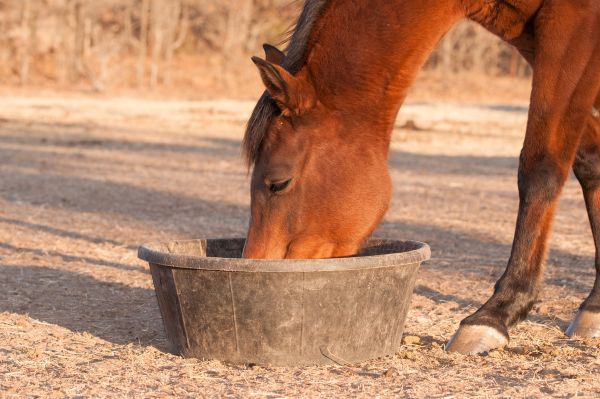
A Colorado State University study evaluated how feeder type influences eating behavior and feed waste. Four geldings were fed three pounds of pelleted feed twice daily, with each meal divided into three one-pound portions and offered one after another in a four-quart, plastic ground pan; a three-gallon plastic hanging feeder; and a shallow trough (40-gallon polyethylene stock tank). Researchers measured total eating time, the number of continuous eating bouts (without lifting the head), and the amount of feed left in the feeder or wasted on the ground. They collected data over 10 days in spring and 5 days in late summer.
Key takeaways:
♦Shallow troughs slowed eating and promoted more consistent intake
♦Ground feed pans and hanging feeders led to faster consumption
♦Ground feed pans led to the most feed waste on the ground
♦Hanging feeders resulted in less feed left behind
Overall, shallow troughs and other feeders with large surface areas are common, economical feeder options that will slow the feed consumption rate while also minimizing feed waste. Although these feeders can benefit many horses, they can especially help in cases where horses are prone to choke, consume large amounts of feed, or bolt their feed.
Learn more about this study, “Effect of feeder style on intake rate of equine concentrates,” by K. O’Reilly, S. Aldworth-Yang, D.N. Catalano: