








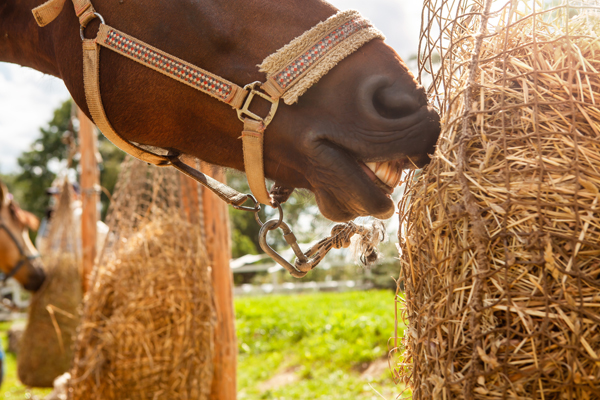
Hay nets and slow feeders offer clear health, welfare, management, and economic benefits but in some cases can create behavioral and musculoskeletal concerns. These management tools must be appropriately implemented to avoid introducing risks.
Researchers reached this conclusion after reviewing 23 studies on hay nets and slow feeders performed between 2009 and 2025.* Those studies looked at the effect of hay nets and slow feeders on feeding behavior, welfare, and health outcomes. Hay nets refer to devices that feature various hole sizes that are hung from a stationary object, such as a stall wall, while slow feeders typically rest on the ground with small- to medium-sized openings.
“Hay nets and slow feeders have become increasingly popular to address welfare concerns associated with feeding. Such concerns include extending feeding times to mimic the natural grazing schedule of feral horses, gastric disorders, and metabolic diseases. Reducing forage waste is another reason these tools are used by horse owners,” explained Kathleen Crandell, Ph.D., a Kentucky Equine Research nutritionist.
Despite being popular for those reasons, scientific evidence supporting hay nets and slow feeders for these purposes is not consistent. A team of veterinary researchers conducted a comprehensive review of the literature to evaluate the effect of hay nets and slow feeders on feeding time, behavior, and forage and health management.
Although more data were available for hay nets than slow feeders, both showed beneficial effects.
Hay nets and slow feeders extend feeding times, benefiting gastric health.
“Hay nets substantially prolonged forage consumption compared to floor feeding,” wrote the researchers. “Smaller mesh sizes, multiple-layered hay nets, and partial net filling all contributed to longer intake times, in some cases more than doubling feeding duration.”
Specifically, studies showed that 3.2-cm mesh nets extended feeding times from 3 hours on the floor to 6.4 hours. Double- and triple-layered nets prolonged feeding times to 9 hours.
Slow feeders also prolonged feeding times, and this effect was greater in ponies than horses.
“From a welfare and health point of view, any method that extends feeding time and helps mimic the continuous forage grazing behavior seen in pastured horses is advantageous. Along with the mental health benefits of prolonged feeding, the steady flow of acid-absorbing material into the stomach may reduce the risk of gastrointestinal disorders such as colic and gastric ulcers,” said Crandell.
Additionally, owners can help protect the sensitive stomach lining of their horse’s stomachs from the continuous production of gastric acid by offering digestive support supplements.
Behavior may improve or worsen with hay nets and slow feeders.
“Some studies show that stereotypic and aggressive behaviors, such as ear-pinning, chasing, biting, kicking, and displacing other horses from the feeder, improved when using hay nets and slow feeders. This was believed to be because extended feeding times more closely matched a natural free-grazing situation,” Crandell said.
The researchers noted, for example, that aggressive movements declined from 25% of interactions before feeding to 9% during feeding when multiple hay bags and nets were provided.
“However, double- and triple-layered hay nets that limited bite size and access to forage sometimes provoked frustration. Horses were observed pawing, biting, and flinging nets three times more often when using double-layered hay nets compared to single nets,” Crandell shared.
Weight management, insulin resistance, and metabolic syndrome may be improved.
Variable results were reported regarding weight management. In one study, horses fed from hay nets lost 9-10 lb (20-23 kg) but that was compared to horses given free-choice access to round bales. Little data are available for slow feeders.
The researchers indicated that regulating intake can help stabilize glucose and insulin responses and that slow feeders show promise in supporting metabolic stability.
Conclusion
“Hay nets and slow feeders can offer important health, welfare, and management benefits when used correctly, but they should not be viewed as a one-size-fits-all solution. Owners are encouraged to pay attention to their horse’s behavior and make adjustments in management as necessary,” advised Crandell.
Additional field studies designed to evaluate how hay nets and slow feeders work in real-world management conditions are encouraged.
*Amaje, J., S. Upton, U.M. Garba, et al. 2025. The use of hay nets and slow feeders as feeding methods in horse management: A semi-systematic review. Journal of Equine Veterinary Science 157:105762.