








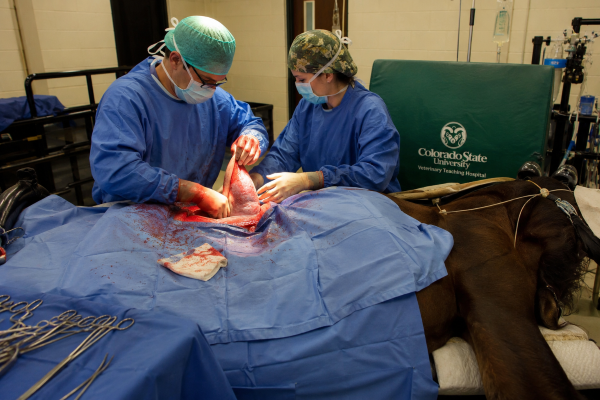
Many studies on colic risk factors, treatment options, and outcomes have been published over the past several decades. Despite these research efforts and attempts at disseminating the information gleaned from these studies, a recent survey reported that some owners resist changing their approach to managing colic cases even when faced with this evidence-based data.*
In the United Kingdom, 1,544 horse owners completed the survey consisting of four parts: owner demographics; views on referral; current knowledge and approach to colic; and impact of evidence-based information on owner decision-making.
The goals of the survey were to describe owners’ current views on colic; identify factors associated with owners’ decision whether to refer a horse for treatment at an equine hospital (either surgical or medical); establish owner’s current understanding on colic recognition and treatment options; and evaluate how evidence-based information affects owner decision making.
Some of the key findings of the survey included:
- In the previous year, 66% of survey respondents had read information on colic, but 24% of survey respondents said they could not remember the last time they read about colic;
- Social media and articles within equestrian publications were the most frequent sources of colic knowledge;
- Financial implications of colic surgery play an important role in the decision-making process; and
- Age was identified as a barrier to referral. Owners were more willing to refer if the horse was insured, being used for ridden work, and if the horse was viewed as a pet or family member rather than a working animal.
Delving into the age issue further, survey respondents indicated they felt a horse was geriatric at the median age of 20 years. Some respondents indicated age was irrelevant and whether a horse was considered “old” was dependent on the individual. Many respondents believed that poor prognosis and demands for surgery and surgical recovery were barriers to referring a geriatric horse for colic.
Survey respondents estimated that 68% of horses discharged following colic surgery would be alive 12 months later, and only 55% would return to full work. However, actual medical evidence paints a much brighter picture.
“The majority of survey respondents were unaware of the evidence reporting 85% of horses discharged following surgery were alive 12 months later and 90% would be in full work 12 months following surgery,” said Catherine Whitehouse, M.S., a nutrition advisor for Kentucky Equine Research.
Interestingly, even after being presented with this optimistic data, decisions by owners regarding colic surgery remained largely unchanged. While 69% of respondents noted they would theoretically consider surgery for a horse over 16, their actual willingness to refer plummeted when facing a real-life geriatric case due to deeply held biases.
In fact, the researchers wrote, “Some owners also refuted the reliability of the information provided within this study as it did not align with what they had previously been told, witnessed or personally experienced.”
Considering that colic is a true emergency and that loss of intestinal vitality can occur as quickly as four hours, efforts need to be taken to avoid this condition.
One previously suggested means of minimizing the chances of colic includes avoiding meal feeding. According to the research study, feeding larger meals only twice a day can cause shifts in water. The body pulls water from the large intestine resulting in impactions. Instead of two large meals, experts recommend offering five or six smaller meals per day to minimize fluid shifts in and out of the intestinal tract.
“Other ways of potentially preventing colic from a nutritional standpoint include supplying a consistent source of good-quality forage, encouraging movement through routine turnout, introducing diet changes slowly, and maintaining hydration by supplying fresh, clean water and supplementing with salt and electrolytes,” Whitehouse suggested.
Owners may also consider offering a product that provides total gastrointestinal tract support to help protect horses against gastric ulcers and hindgut acidosis.
“Such products will also help stabilize a healthy population of microbes that play a key role in fiber fermentation, energy production, and maintaining a healthy intestinal lining,” Whitehouse explained.
*Burrell, K.L., G.C.W. England, J.H. Burford, and S.L. Freeman. 2026. Impact of evidence-based information on horse owners’ misconceptions of colic. Equine Veterinary Journal:70170.