





Reflections of a Horse Show Judge by Bonnie Miller

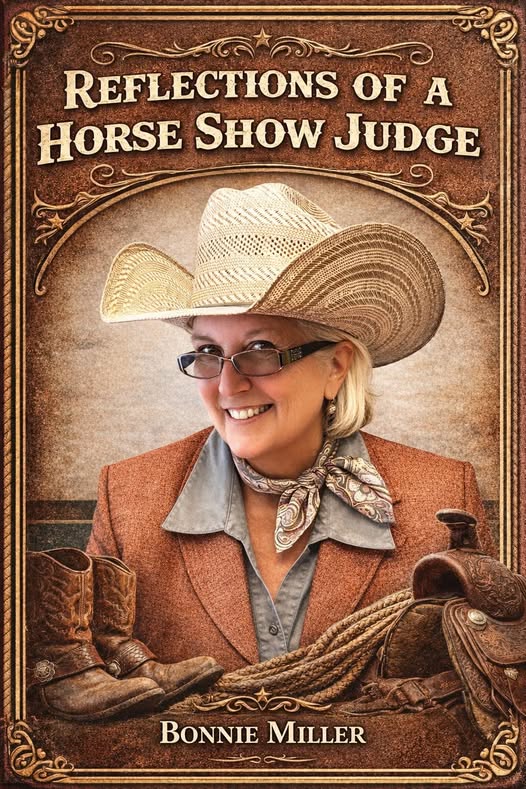
By Bonnie Miller
One of the most meaningful parts of my life has been my time as a horse show judge. I began judging small, local shows while I was still in college. As my career evolved, I became more involved in training and showing Paints and Quarter Horses, eventually competing at major shows across the United States and Canada. I was fortunate to find success in the show pen—but like every exhibitor, I also developed strong opinions about the judges on the other side of the rail.
Back then, judging wasn’t as structured as it is today. There were no clearly defined scoring systems. In classes like trail, reining, and western riding, we relied on what we called the “thermometer system.” You started at a score of 70, and from there, the number rose or fell based on the judge’s overall impression of the run—no specific penalties, just a feel for how the performance came together. Rail classes were judged more comparatively, much like they are now, evaluating each horse against the others based on movement, correctness, and responsiveness through all gaits and transitions.
There were judges we trusted—judges we respected. Names like Burdette Johnson, Harry Hurd, Bud Gochenauer, Bill Lewis, Jack Dreschler, Larry Myerscough, Robert Milkie, and Jim Becker stood out to many of us as both knowledgeable and fair. I’m sure there are others I’m not recalling at the moment, but those were the ones we felt confident showing under.
Judging has always carried the stigma of being “political.” It’s an easy accusation—that certain riders are favored and placed higher than they deserve. Over time, I’ve come to see it a little differently. The truth is, the more prominent trainers often do bring better horses to the pen. They have access to stronger bloodlines, more natural talent, and the experience to present those horses at their very best. More often than not, they should be near the top.
Where things can become complicated is when a judge lacks confidence or depth in a particular discipline. In those moments, it can be tempting—perhaps even subconscious—to rely on familiarity, to default to the riders who are known for having quality horses. That’s where unintentional bias can creep in.
Even with today’s structured scoring systems, this kind of subtle imbalance can still happen. Take a trail class with ten obstacles. If one horse performs consistently at a strong zero or a weak plus half, and a judge leans conservative on one run and generous on another, the scores can separate quickly. One horse might stay at a 70 while another climbs to a 75, not because of a dramatic difference in performance, but because of small, cumulative decisions. The posting of score sheets has certainly improved accountability, but it doesn’t eliminate the human element.
A friend of mine, Terry Helder, once said he’d rather show to a political judge than a poor one—because a political judge might only get the winner wrong, while a poor judge could get the entire class wrong. There’s a surprising amount of truth in that.
I remember a show in Columbus, Ohio. Larry and I had several horses and clients there, and after one class, I rode back to the stalls feeling invisible—like I hadn’t even been considered. Frustrated, I told everyone that I was going to get my judge’s card and make sure that when I judged, every single horse would be seen and given a fair chance.
Not long after, I attended a judges seminar in Indianapolis—the precursor to the Color Breed Council seminars—and earned my Pinto card, followed by my Paint card. From that point forward, I never forgot why I chose to judge. Every time I pulled onto a show ground, I reminded myself of the effort it took for each exhibitor to get there—the early mornings, the long hauls, the preparation. Every horse deserved to be evaluated by the same standard. It didn’t matter what saddle they used, how they were dressed, or how well-known they were. What mattered was performance, execution, and horsemanship.
The industry has long pushed the idea that success depends on presentation—on having the right look, the right equipment, the right image. And while some judges do get caught up in that, I made it a point not to. I was too focused on what was happening underneath the rider to be distracted by the rest.
Over the years, I’ve learned invaluable lessons from others. One of the most important came from Patti Carter, who said to judge the horse from the ground up and from back to front. Simple advice, but incredibly powerful. She also emphasized the importance of movement as a judge—if the horses are circling you one direction, turn the opposite way to ensure you’re seeing every angle. Small adjustments like that make a big difference.
And then there are the moments you never forget.
I was judging a small show in Arab, Alabama, working a pleasure class. By the end of the jog, I had already sorted the horses in my mind. The other judge called for the lope, and as one horse picked it up in front of me, everything changed. Within two strides, I was watching the most beautiful lope I had ever seen. I had placed him somewhere in the middle based on the jog—but in that instant, I was captivated. That was my introduction to Fleet Machine.
Moments like that are humbling. They remind you that no matter how experienced you are, you must stay open, attentive, and willing to adjust.
Because judging—true judging—isn’t just about placing horses. It’s about seeing them!
Bonnie, we are humbled by the honor to post your article! Thank you so much!
If you have a blog to submit for consideration, please email it to: Delores.Kuhlwein@EquineChronicle.com.