








The Calm Advantage: Why Regulation Creates Better Movement and Better Rounds

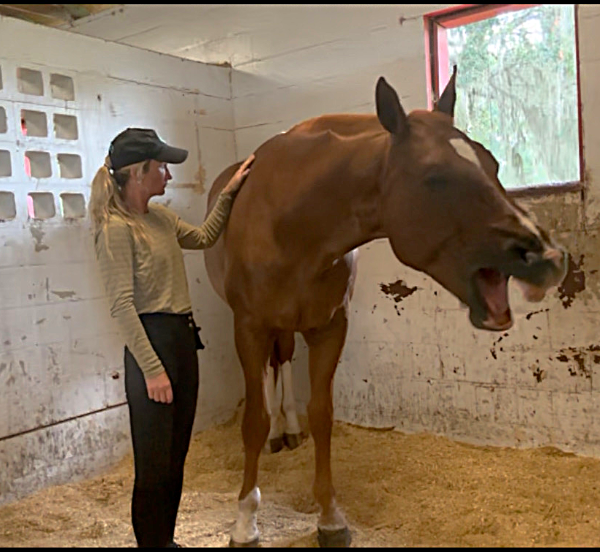
Photos courtesy of Farmhouse Chiropractic.
Performance is a Team Sport-and Nervous Systems are Contagious:
A Three Part Series by Dr. Jillian Johnson of Farmhouse Chiropractic at WEC-Ocala.
Part One:
The Calm Advantage: Why Regulation Creates Better Movement and Better Rounds
In the show world, we often focus on what we can measure — fitness goals, training schedules, strength development, and performance milestones. But the most consistent horses over time tend to share something less obvious: they’re regulated. Not quiet or dull, but able to shift between effort and softness without living in brace.
When a horse is stuck in a high-alert state, the body adapts. Muscle tone increases. Breathing becomes shallow. The jaw tightens. The ribcage becomes rigid. Stride shortens, transitions require more effort, and “softness” becomes harder to access — not due to attitude, but due to physiology. The nervous system is simply trying to protect.
The goal isn’t to slow down in the sport — it’s to support the horse so they can stay in the sport longer. Regulation gives the horse the ability to process stimulation without bracing, release tension rather than hold it, and recover fully between demands. That’s where swing, elasticity, and consistency come from.
Of course, horses don’t live in a vacuum. Many of the tension patterns we see in performance horses are mirrored by the riders who love them — busy schedules, travel, adrenaline, high expectations. Performance is a team sport — and nervous systems are contagious. When the rider is supported and regulated, the ride often changes immediately: softer hands, clearer timing, and a horse that feels safe enough to release.
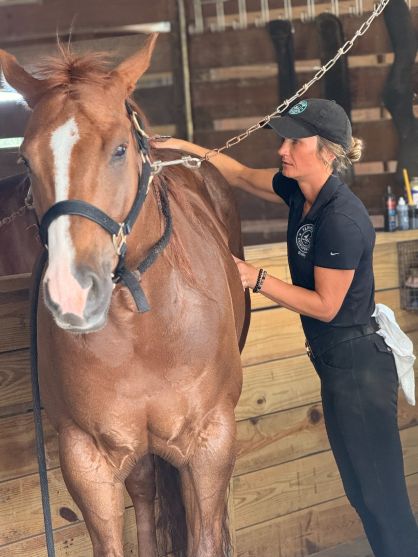 At Farmhouse Chiropractic, we view chiropractic care as nervous system care — because the nervous system coordinates movement, recovery, and regulation. When motion is restricted or stress is high, the body responds with protective tension that can quietly interfere with expression and performance. Our standard is to decrease that interference so the horse can access their fullest movement — with more ease, softness, and longevity. And because performance is a partnership, we also support the rider: the most elastic horses are often paired with the most regulated humans. That’s why our care is intentionally integrative: precise chiropractic care and bodywork, advanced recovery modalities that support tissue health and circulation, and nervous system–based techniques that help the system downshift, reset, and stay soft, present, and expressive. The result isn’t just improved performance — it’s a horse (and rider) who feels better in their body.
What the best programs prioritize (The Farmhouse Standard)
The most successful performance programs build regulation into the routine in subtle, consistent ways — because they understand that a regulated nervous system is the foundation of elasticity, learning, and longevity. They protect true recovery (not just physical rest, but nervous system decompression), and they treat softness as a baseline — not something to force or “train into” the horse. At Farmhouse, this is our standard: we look for the signs the system can breathe, soften, and adapt, and we address restriction early before the body has to compensate. Over time, these small priorities create a horse that stays elastic under pressure, recovers more efficiently between demands, and performs with more consistency — because the body isn’t constantly protecting.
Regulation isn’t weakness — it’s refinement. When the nervous system feels safe enough to release tension, movement becomes more elastic, training becomes clearer, and performance becomes easier to access. Longevity is the new luxury — and regulated horses stay expressive, consistent, and sound for years.
Unlock the Full Potential of You and Your Animal Partner
Elevated Chiropractic Care | Equestrian, Equine, K9