








LSU Vet Med Researchers Investigating Equine Herpesvirus

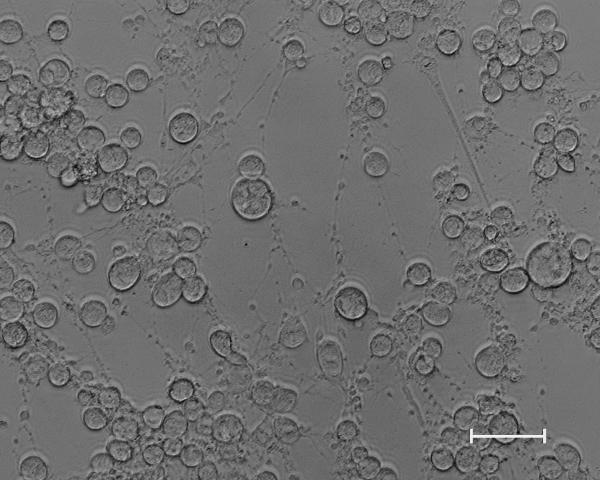
Microscopic image of Equine herpesvirus-1, credit LSU.
Baton Rouge—In November 2025, there was an outbreak of Equine herpesvirus-1 (EHV-1), which predominantly causes respiratory signs but can cause issues such as neurologic disease and abortion in pregnant mares. LSU School of Veterinary Medicine researchers are investigating EHV-1 to determine where the virus resides in the body during latency. This could help develop a vaccine for the neurologic version of the virus (there is currently a vaccine for the respiratory version).
Learn more about LSU’s role in treating horses affected by the outbreak
LSU Vet Med Department of Pathobiological Sciences faculty members Udeni Balasuriya, BVSc, Ph.D., professor; Côme Thieulent, Ph.D., assistant research professor; and Mariano Carossino, DVM, Ph.D., associate professor of veterinary pathology, were awarded a Charles V. Cusimano Equine Health & Sports Performance Research Grant to investigate the “Rapid detection of latent equine respiratory herpesviruses in peripheral blood mononuclear cells and peripheral tissues by multiplex one-step dPCR assays.”
This project focuses on improving how veterinarians detect latent EHV-1. One major challenge is that herpesviruses can become latent, meaning they hide inside a horse’s cells without causing clinical signs. The virus can be reactivated by several factors (e.g., stress, immune suppression) and the virus can then spread to susceptible horses. Outbreaks can be difficult to predict or control, as we saw in November 2025. These researchers working to develop a rapid, highly sensitive molecular digital PCR assay to detect these hidden infections before they lead to disease and new outbreaks. This tool will be invaluable for vaccine development as researchers gain a better understanding of exactly where the virus resides during these latent periods.
EHV-1 outbreaks can halt competitions where horses are present, affect breeding operations, and lead to severe illness. By giving veterinarians a clearer picture of the virus during latency, this project could improve animal health and welfare and disease control for horses.
About LSU Vet Med: Bettering lives through education, public service, and discovery
The LSU School of Veterinary Medicine is one of only 33 veterinary schools in the U.S. and the only one in Louisiana. LSU Vet Med is dedicated to improving and protecting the lives of animals and people through superior education, transformational research, and compassionate care. We teach. We heal. We discover. We protect.