






Injured Roping Horse Returns to Competition After Extensive Hospitalization and Rehabilitation

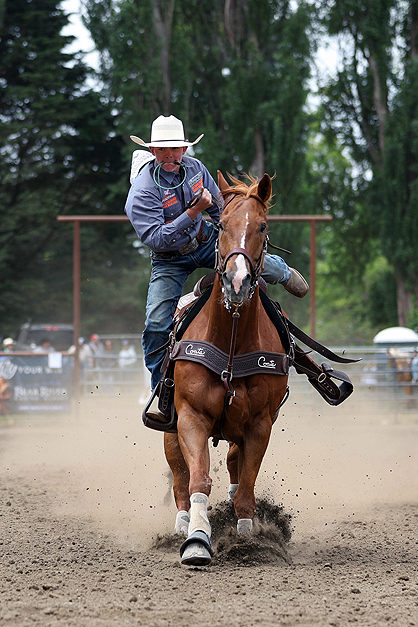
Jackson Bacon competing on Ricky. (Ali Lynn Photography)
“Case of the Month” – December 2025
By Rob Warren, UC Davis School of Veterinary Medicine
Two years ago, Brandon and Lisa Bacon were looking to purchase a horse for their 12-year-old son Jackson. Through their contacts as the owners of a horse supply company in Northern California, they discovered Ricky, a then 13-year-old American Quarter Horse gelding.
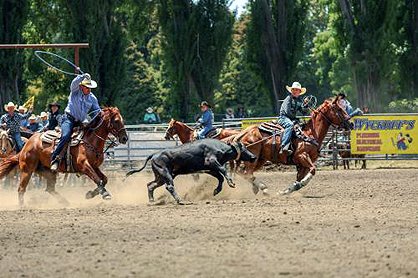
Jackson Bacon (right), as the lead roper, on Ricky in a team roping competition. (Ali Lynn Photography)
“Jackson has big ‘Gold Buckle’ dreams,” Lisa said. “We’re so proud of how hard he works at this, and we were thrilled to find Ricky, who was already an experienced roping horse.”
Upon initial inspection, Brandon and Jackson instantly fell in love with how good Ricky was as a roping horse. Jackson immediately felt safe on Ricky, so the Bacons knew he was the right horse for their son.
About a year after acquiring Ricky, following an unwitnessed fall during turnout, the Bacons found Ricky with “road rash” on his head and injuries to both front knees, with his right front leg taking the brunt of the fall.
“We keep Ricky in a very safe environment,” said Lisa. “I think this was just one of those fluke accidents where you can only protect them so much. It was horrible. There was a large gash over his right knee—butterflied open—with a hole that went right into his knee joint.”
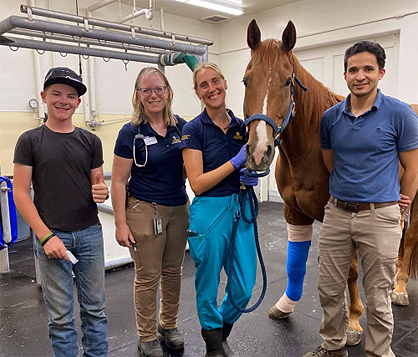
Ricky at the UC Davis veterinary hospital with (l to r) Jackson Bacon, Dr. Julie Dechant, (then) DVM student (now Dr.) Sarah Smith (’25), and Dr. David Orozco Lopez.
The Bacons immediately called their primary veterinarian, UC Davis School of Veterinary Medicine (SVM) alumna Dr. Hannah Case (’24) of Cotati Large Animal. Dr. Case flushed the area and observed joint fluid in the wound. She instructed the Bacons to get Ricky to UC Davis right away.
When Ricky arrived at the UC Davis Large Animal Hospital, the equine emergency team was waiting for him. Radiographs showed no bony injuries and the presence of mild gas in the soft tissues around the right carpal joints with suspicion the wound communicated with the joint space. Further testing confirmed that the wound communicated with the middle carpal joint.
A horse’s carpal joint is enclosed in a capsule lined with a membrane that produces lubrication. This “sack” of fluid allows smooth movement of the joint and nourishes the cartilage. Ricky’s carpal joint “sack” was punctured, and the protective fluid was leaking out. Wounds involving synovial structures, such as joints, are best managed with arthroscopic lavage to thoroughly flush the joint and remove any foreign material. Ricky’s wound prevented arthroscopic lavage because of the extensive damage and contamination to the tissues in front of his joint.
Faculty equine surgeon Dr. Julie Dechant and equine surgery residents Drs. David Orozco Lopez and Laurel Saldinger performed a standing procedure on Ricky to lavage the joint, debride and clean the wound, and then suture the wound closed to seal the puncture to the carpal joint.
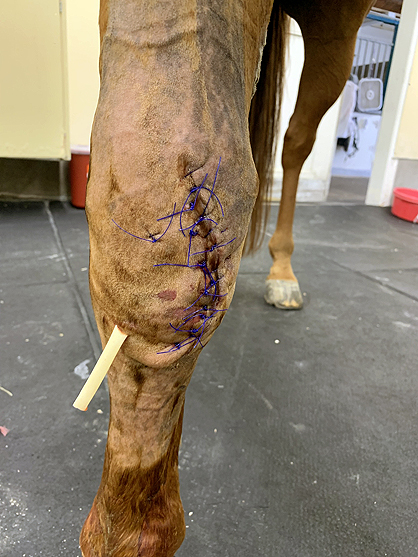
Ricky’s right middle carpal joint was lavaged using a needle and a pressure bag to deliver fluids through the joint. Meanwhile, dirt and debris were removed from the wound bed using multiple debridement techniques and a high-pressure surgical lavage system. A drain was placed until the skin flap to prevent fluid from building up under the skin flap, and the skin flap was sutured back in place using tension relieving sutures.
-
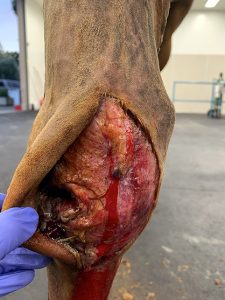
- Day 1
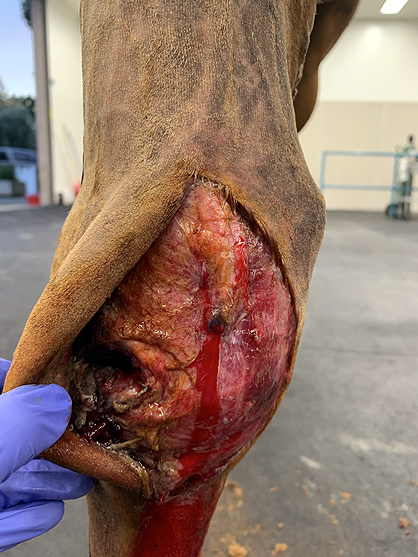
-
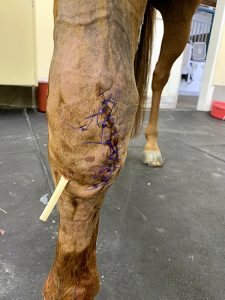
- Day 3
-
- Day 6
-
- Day 88
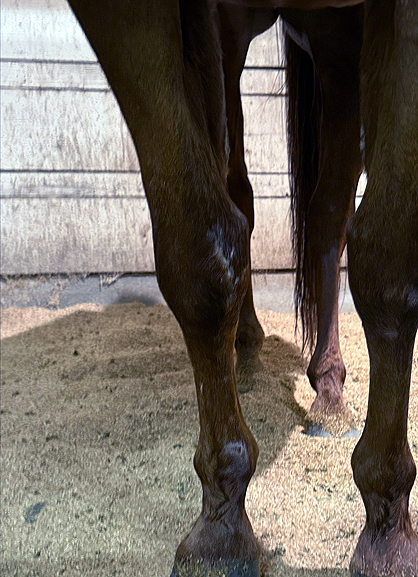
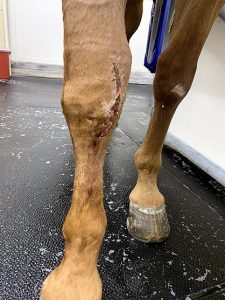
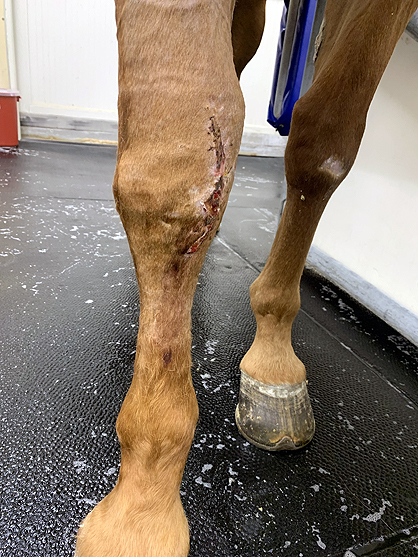
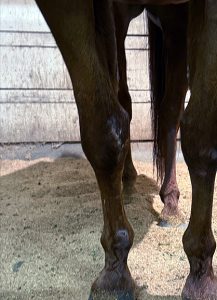
Ricky was hospitalized for 19 days for systemic, regional, and local antibiotic treatment and daily bandage changes. Fluid from the affected middle carpal joint was analyzed on multiple occasions following the repair to ensure that there were no signs of joint infection. Part of his recovery involved the use of a full-length leg splint to prevent any joint motion, because the constant movement of this high motion joint prevented sealing of the wound and the joint.
“My son is so attached to that horse,” Lisa said. “We were traveling to the hospital about every other day to see Ricky and bring him treats. We’re so grateful to UC Davis for allowing us that visiting time. It helped us so much to get through the ordeal. Seeing your amazingly fit horse immobilized in the hospital is hard to deal with.”
When Ricky was well enough to be discharged (August 2024), Dr. Orozco Lopez detailed a gradual recovery plan and provided rehabilitation exercises to perform at home. The Bacons then worked with Ricky’s performance veterinarian, SVM alum Dr. James Myers (’13) of Gold Coast Equine, and their farrier Brian Graham, to optimize his care at home. The team was confident that Ricky would be ready to return to normal work training by January 2025.
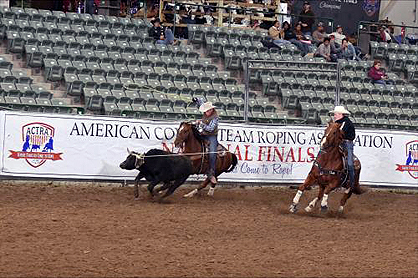
Jackson Bacon (right) competing on Ricky in the 2025 ACTRA National Finals. Jackson lead roper, Ali Lynn Photography.
“I would’ve never believed that this horse, which was completely immobile in a hospital, could return to training in five months,” Lisa said. “But they were right.”
By February 2025, Ricky and Jackson were competing in his junior high school rodeo goat roping competitions. A short time later, they worked Ricky back into team roping with steers. By June 2025, they were competing in the school state rodeo finals.
Ultimately over the spring and summer of 2025, Ricky and Jackson would complete the ten American Cowboy Team Roping Association (ACTRA) preliminary competitions to qualify for the 2025 ACTRA National Finals in October 2025.
Ricky and Jackson will continue competing through school and state/national events going forward with high hopes of what the future holds.
“Jackson seems to get on top of the mountain when he tells everyone how good UC Davis is and what they did to save his horse,” said Lisa. “It brings tears to my eyes. It’s such an incredible story of recovery, and we’re so thankful. The outcome couldn’t have been better – Ricky seems better now than he ever was.”